

By Montessori Toys · Updated July 2026 · 18 min read
Pencil Grasp Development by Age: A Complete Stage-by-Stage Guide (and Why You Should Not Rush It)
In this guide:
- Why pencil grasp develops in stages, not all at once
- Stage 1: power grasp (age 1 to 2)
- Stage 2: digital pronate grasp (age 2 to 3)
- Stage 3: four-finger and static grasp (age 3.5 to 4.5)
- Stage 4: quadrupod grasp (around age 4.5)
- Stage 5: mature dynamic tripod grasp (age 5 to 7)
- The complete grasp development chart
- Why rushing a tripod grasp backfires
- Function over form: the question that matters more than grip style
- Toys and activities that support each stage
- When to seek professional support
- Frequently asked questions
If you have been working through our sensory-fine motor series and finally have a routine that helps your child engage with hands-on activities, the natural next question is where all of this is actually heading. For most parents, that answer is handwriting. This guide breaks down exactly how pencil grasp develops, stage by stage, and why the instinct to correct a "wrong" grip early can actually do more harm than good.
Why Pencil Grasp Develops in Stages, Not All at Once
Pencil grasp is not a skill a child either has or does not have, it is the visible output of a much larger set of underlying strength and stability gains happening in the shoulder, arm, wrist, and hand over several years. Early grasp patterns rely on movement from the shoulder, since the muscles closer to the trunk mature before the smaller, more distal muscles in the fingers
As a child gains what occupational therapists call proximal stability, meaning trunk and shoulder control, movement gradually shifts down the arm, first to the elbow, then the wrist, and finally to the fingers themselves. This is why a toddler draws with their whole arm swinging from the shoulder, while an older child can write for long periods using only small finger movements. Every stage in this guide reflects one more step in that shift from big, proximal movement to small, precise, distal movement.
Stage 1: Power Grasp (Age 1 to 2)
The first grasp pattern to develop is a whole-fist grasp, sometimes called a palmar-supinate or power grasp, where the child holds a crayon in their fist like a dagger and marks the page using movement from the entire arm and shoulder . There is no precision at this stage, and children strongly prefer working on a vertical surface, like an easel or a wall, because the whole-arm movement suits an upright surface far better than a flat table.
This stage develops the power side of the hand, the ring and pinky fingers, the same side used in an early raking grasp when picking up food . There is no need to correct or refine this grasp at this age, it is the expected, necessary starting point for every child.
Stage 2: Digital Pronate Grasp (Age 2 to 3)
Around age 2, the grasp shifts slightly, the palm now faces down toward the paper, and the crayon is held by all the fingers and thumb together rather than in a closed fist . Movement at this stage comes primarily from the elbow rather than the shoulder, a small but meaningful step toward more controlled marks .
Children at this stage are just beginning to access the precision side of their hand, the thumb and index finger, but have not yet learned to separate the two sides of the hand efficiently, so the grasp can still look somewhat awkward . A vertical surface is still generally preferred over a flat table during this stage
Stage 3: Four-Finger and Static Grasp (Age 3.5 to 4.5)
By around 3.5 to 4 years old, most children hold a pencil between the thumb and four fingers, with the pencil in a nearly upright position, and movement now comes primarily from the wrist rather than the elbow . Some sources describe a closely related pattern in this window called the digital grasp, where the pencil is held with the thumb and three fingers with a straight wrist.
This progresses into what is sometimes called a static tripod or static quadrupod grasp, where the fingers are nearly in the mature writing position, but the space between the thumb and index finger, called the space, is still narrower than it will eventually become. Movement at this point comes from the wrist and larger finger movements rather than the fine, isolated finger movements that appear later
Stage 4: Quadrupod Grasp (Around Age 4.5)
Around age 4.5, many children develop a dynamic tripod or quadrupod grasp, where the pencil is controlled by the thumb, index finger, and middle finger, supported by the ring finger, with the wrist now slightly bent back rather than straight A quadrupod grasp specifically uses four fingers for control rather than three, and both this pattern and the tripod pattern that follows are considered functional, appropriate grasps for precise writing and drawing
By this stage, proximal stability, trunk and arm strength, has developed enough that the hand can rest comfortably on the table while the power side of the hand stabilizes and the precision side does most of the actual movement.
Stage 5: Mature Dynamic Tripod Grasp (Age 5 to 7)
The mature dynamic tripod grasp, generally considered the most efficient grip for both right and left-handed writers, holds the pencil between the thumb and index finger, supported by the middle finger, with the ring and little fingers gently curled into the palm . This grip creates a wide, openspace between the thumb and index finger, which allows movement to come almost entirely from small finger movements rather than the wrist or elbow .
Importantly, many children do not reach this fully mature grip until age 5 to 6, and some sources place full maturity as late as age 6 to 7 . This means a large number of children entering kindergarten are still using a transitional grasp, and that is developmentally normal, not a sign of delay.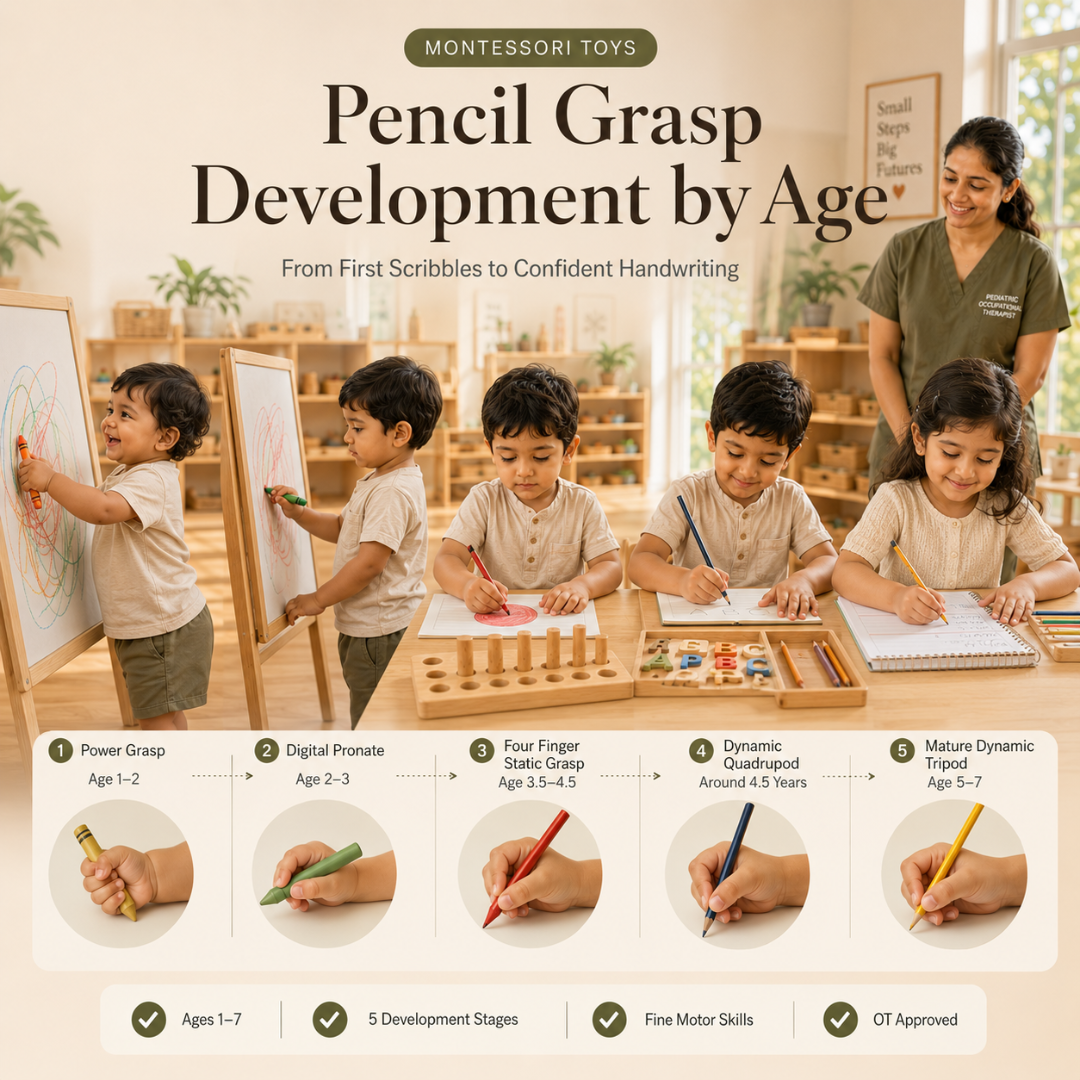
The Complete Grasp Development Chart
| Age | Grasp Pattern | Movement Source |
|---|---|---|
| 1 to 2 years | Power / palmar-supinate grasp (whole fist) | Shoulder |
| 2 to 3 years | Digital pronate grasp | Elbow |
| 3.5 to 4.5 years | Four-finger / static tripod or quadrupod grasp | Wrist |
| Around 4.5 years | Dynamic quadrupod grasp | Fingers, wrist support |
| 5 to 7 years | Mature dynamic tripod grasp | Fingers |
These ages are typical ranges, not strict deadlines, every child moves through these stages at their own pace depending on their individual strength and stability development
Why Rushing a Tripod Grasp Backfires
It is tempting to teach a toddler the "correct" tripod grip as early as possible, but occupational therapy guidance is clear that this often backfires. If a child is taught to hold a pencil in a tripod grip before they are physically ready, they tend to develop a poor, compensatory grip that becomes difficult to correct once they are older
This happens because the tripod grip depends