

By Montessori Toys · Updated July 2026 · 18 min read
Building a Sensory-Friendly Fine Motor Routine: Putting Vestibular, Proprioceptive, and Tactile Strategies Together
In this guide:
- Why addressing one sense at a time often falls short
- A quick recap of the three sensory systems
- Identifying your child's sensory profile
- A real clinical example: combining brushing and joint compression
- A complete daily sensory-fine motor routine
- Matching toys to your child's sensory profile
- Common mistakes when combining sensory strategies
- Tracking what actually works for your child
- When to seek professional support
- Frequently asked questions
Across our last three guides, we looked at proprioceptive seeking, vestibular seeking, and tactile defensiveness or seeking as separate topics. In real life, they rarely show up in isolation. A child who spins constantly might also crash into furniture and refuse to touch glue. This guide brings all three threads together into one practical daily framework, so you are not left wondering which article applies to your child, or worse, trying to run three separate strategies at once.
Why Addressing One Sense at a Time Often Falls Short
Occupational therapists rarely treat a single sensory system in isolation, because in practice, the vestibular, proprioceptive, and tactile systems constantly interact and influence each other. A child overstimulated by vestibular movement is calmed most effectively with deep pressure, a proprioceptive strategy, not with more vestibular input or with a purely tactile approach This overlap means a routine built around only one sense will often miss the other needs quietly driving the same behavior.
- This is also why clinical occupational therapy protocols, like the widely used Wilbarger brushing protocol, deliberately combine two sensory systems in a single sequence, tactile brushing followed immediately by proprioceptive joint compressions, rather than treating either sense alone as sufficient3
A Quick Recap of the Three Sensory Systems
| System | Seeking Behavior | Best Regulating Input |
|---|---|---|
| Vestibular | Spinning, swinging, rocking, climbing and jumping | Goal-directed movement with a clear start and stop |
| Proprioceptive | Crashing, pushing, pulling, craving deep pressure | Heavy work: carrying, pushing, squeezing against resistance |
| Tactile | Avoiding or craving certain textures | Gradual exposure (defensive) or texture-rich tools (seeking) |
Notice that proprioceptive input, deep pressure specifically, shows up as a calming strategy across all three systems, which is why heavy work is often the most efficient single tool when you are not sure exactly which sense is driving a behavior in the moment
Identifying Your Child's Sensory Profile
Rather than trying to categorize your child perfectly, it is more useful to simply notice which behaviors show up most often across a typical day. Ask yourself:
- Does my child seek out spinning, swinging, or jumping more than most children their age? (vestibular seeking)
- Does my child crash into things, crave tight hugs, or constantly push and pull objects? (proprioceptive seeking)
- Does my child avoid certain textures, messy play, or specific clothing fabrics? (tactile defensiveness)
- Does my child touch everything within reach or seem unable to keep hands off objects and people? (tactile seeking)
Most children will show some combination, and the goal is not a perfect diagnosis, it is simply enough awareness to know which two or three strategies from our earlier guides to prioritize first.
A Real Clinical Example: Combining Brushing and Joint Compression
The Wilbarger brushing protocol is a well-documented example of exactly this kind of combined approach, and it is worth understanding even in outline form because it demonstrates the underlying principle so clearly. The protocol uses a specific surgical brush to provide firm, deep tactile input to the arms, legs, back, and hands, and this brushing step is always immediately followed by joint compressions, a proprioceptive input applied to the same limbs
Occupational therapists specifically note that brushing alone is incomplete, it is the follow-up joint compression that helps the child's nervous system fully process and organize the tactile input just received This single detail captures the core lesson of this entire guide: a single sensory input given in isolation is often less effective than two complementary inputs given in deliberate sequence. Parents are advised to implement this specific protocol only under the guidance of a trained occupational therapist, but the underlying principle, pairing tactile input with proprioceptive follow-up, can be adapted safely at home using simpler tools like firm hand squeezes after a texture-based activity.
A Complete Daily Sensory-Fine Motor Routine
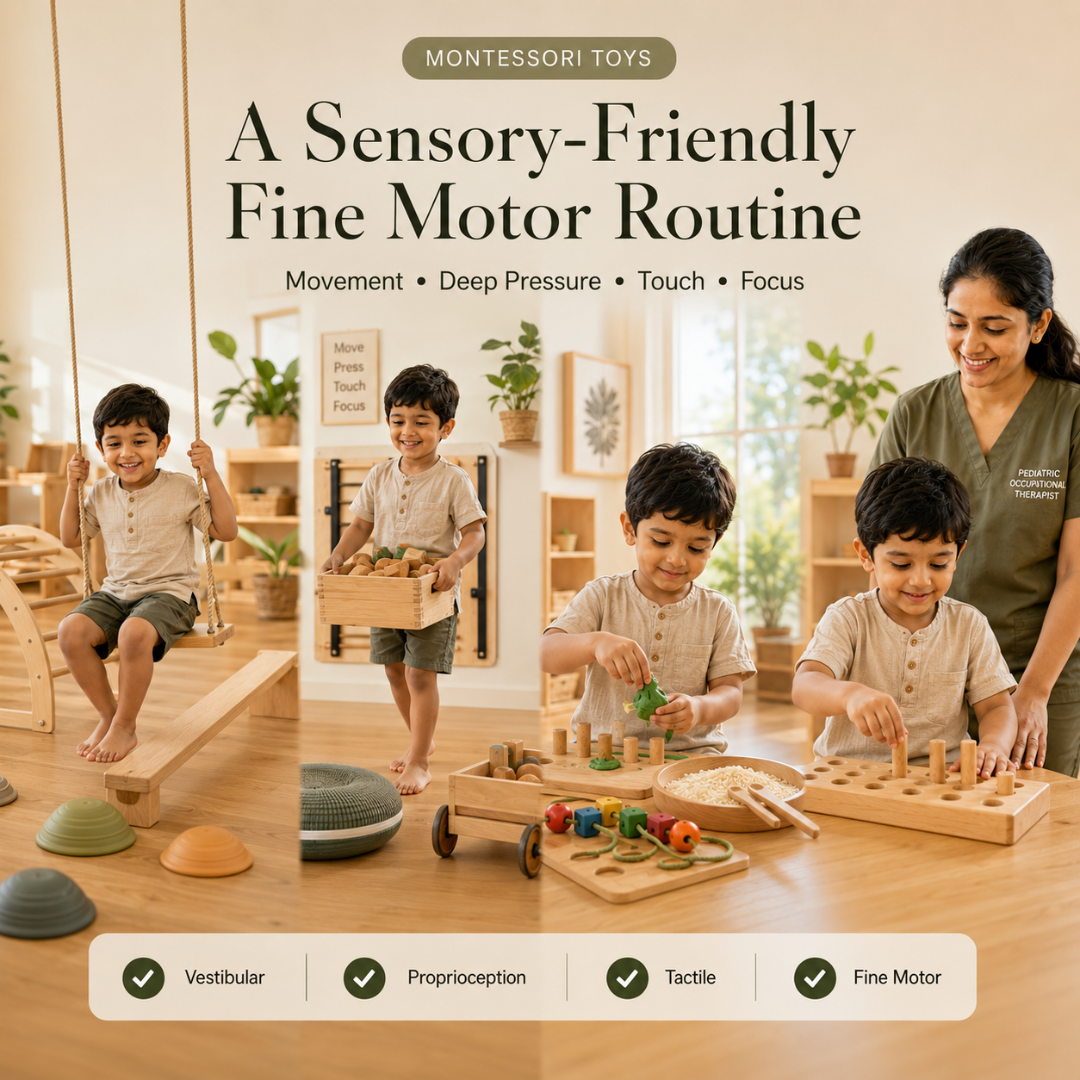
Bringing together the sequencing principles from all three of our earlier guides, here is a full routine that layers vestibular, proprioceptive, and tactile input around a short fine motor session:
- Step 1, vestibular input (2 to 3 minutes): A structured, goal-directed movement activity, like a counted number of swing pumps or trampoline jumps, with a clear stop point
- Step 2, proprioceptive input (2 to 3 minutes): Heavy work immediately after, like carrying a weighted basket or doing wall push-ups, which also helps settle any vestibular overstimulation from step 1
- Step 3, tactile warm-up (1 to 2 minutes): A brief texture-appropriate activity matched to your child's profile, tongs and putty for a tactile defensive child, or a quick sensory bin dip for a tactile seeker
- Step 4, the fine motor task: Introduce the peg board, lacing toy, or puzzle immediately while the regulating effects of steps 1 through 3 are still active
- Step 5, calming close-out (1 minute): A firm hug, hand squeeze, or brief quiet moment, mirroring how clinical sensory protocols always end with an organizing, calming step rather than ending abruptly after stimulating input
- Repeat: Run this full 8 to 10 minute cycle two to four times across the day rather than expecting one long, single session to work
This sequence is intentionally short. The goal on any given cycle is not a long, sustained fine motor session, it is a realistic, repeatable win, even two or three minutes of genuine engagement with the fine motor task counts as success, especially when repeated consistently across the day.
Matching Toys to Your Child's Sensory Profile
| Profile | Toy Feature to Prioritize |
|---|---|
| Vestibular seeker who also needs deep pressure to settle | Heavier peg board base for stability, firm resistant pegs |