

By Montessori Toys · Updated July 2026 · 18 min read
Sensory Seekers and Fine Motor Skills: Why Some Kids Need to Move to Focus
In this guide:
- What sensory seeking actually means
- Proprioception: the sense most parents have never heard of
- The gas tank metaphor occupational therapists use
- Why fine motor tasks are especially hard for sensory seekers
- What a sensory diet actually is
- Heavy work: the missing step before fine motor practice
- A real sensory diet schedule from occupational therapy practice
- How therapists actually combine sensory input with fine motor tasks
- Building a simple sensory-fine motor routine at home
- Fine motor tools that work well for sensory seekers
- Sensory seeker or just an active toddler?
- When to seek professional support
- Frequently asked questions
If you have already tried standing peg boards, floor-based lacing, and short movement bursts with your active child and still feel like something deeper is going on, it may be worth looking at this through a sensory lens rather than just an energy lens. Some children are not simply energetic, they are sensory seekers, meaning their nervous system genuinely craves more physical input than average to feel calm and focused. Understanding this distinction, and the occupational therapy concepts behind it, changes the entire approach to fine motor practice.
What Sensory Seeking Actually Means
Sensory seeking describes children whose nervous system under-registers certain types of sensory input, so they actively seek out more of it to feel regulated. This shows up as constant movement, crashing into furniture or people, jumping, spinning, or needing to touch and manipulate everything within reach.
This is different from a child who is simply bored or has typical toddler energy. A sensory seeker's need for movement is a physiological requirement, not a preference, which means the usual advice of "just make the activity more interesting" often does not work, because the problem is not engagement, it is an unmet sensory need.
Proprioception: The Sense Most Parents Have Never Heard Of
Beyond the five senses most people know, the body also has a proprioceptive sense, the ability to feel where the body is in space through input from the muscles and joints. Children who seek deep pressure, crash into cushions, or push and pull heavy objects are often trying to satisfy an under-registered proprioceptive sense.
This matters directly for fine motor development because the hands and fingers rely on accurate proprioceptive feedback to judge grip strength and control small movements precisely. A child whose proprioceptive system is under-responsive may press too hard, drop objects unexpectedly, or seem unable to modulate the delicate pressure a pincer grasp task requires, not because they lack the muscle strength, but because their body is not receiving clear signals about how much force they are actually using.
The Gas Tank Metaphor Occupational Therapists Use
Pediatric occupational therapists frequently explain sensory needs to parents using a simple gas tank analogy. The goal of sensory input is to fill a child's tank with enough fuel so they can efficiently function throughout the day without running on empty. A child whose sensory tank is empty cannot simply be told to focus, the same way a car cannot run without fuel regardless of how firmly you turn the key.
This reframes the entire problem. Instead of viewing movement-seeking behavior as defiance or distraction, it becomes information, a signal that the child's tank needs filling before any calm, focused task, including fine motor practice, has a real chance of success.
Why Fine Motor Tasks Are Especially Hard for Sensory Seekers
Fine motor tasks demand exactly the kind of controlled, precise, low-intensity movement that runs counter to what a sensory seeking nervous system is asking for. Sitting still and manipulating small objects requires the body to be calm and regulated first, but a sensory seeker's body is often in a state of active seeking, restless and unsettled, which makes the fine, controlled movement of a peg board or lacing task feel almost uncomfortable to sustain.
This explains a pattern many parents notice but cannot quite articulate: a sensory seeking child may be perfectly capable of the fine motor skill itself, showing brief flashes of real precision, but is unable to sustain the activity for more than a few seconds before their body pulls them toward bigger movement.
What a Sensory Diet Actually Is
A sensory diet is a structured plan of individualized sensory activities, delivered at specific frequencies throughout the day, designed to support a child's regulation so they can better participate in daily tasks like eating, learning, and playing. The term "diet" here does not refer to food, it refers to a planned intake of sensory experiences, spaced out across the day the same way meals are spaced out to maintain steady energy.
A sensory diet is typically built by an occupational therapist around a specific child's needs, but the underlying structure, short bursts of physical, regulating activity woven between calmer tasks, is something parents can adapt at home even without a formal OT-designed plan.
Heavy Work: The Missing Step Before Fine Motor Practice
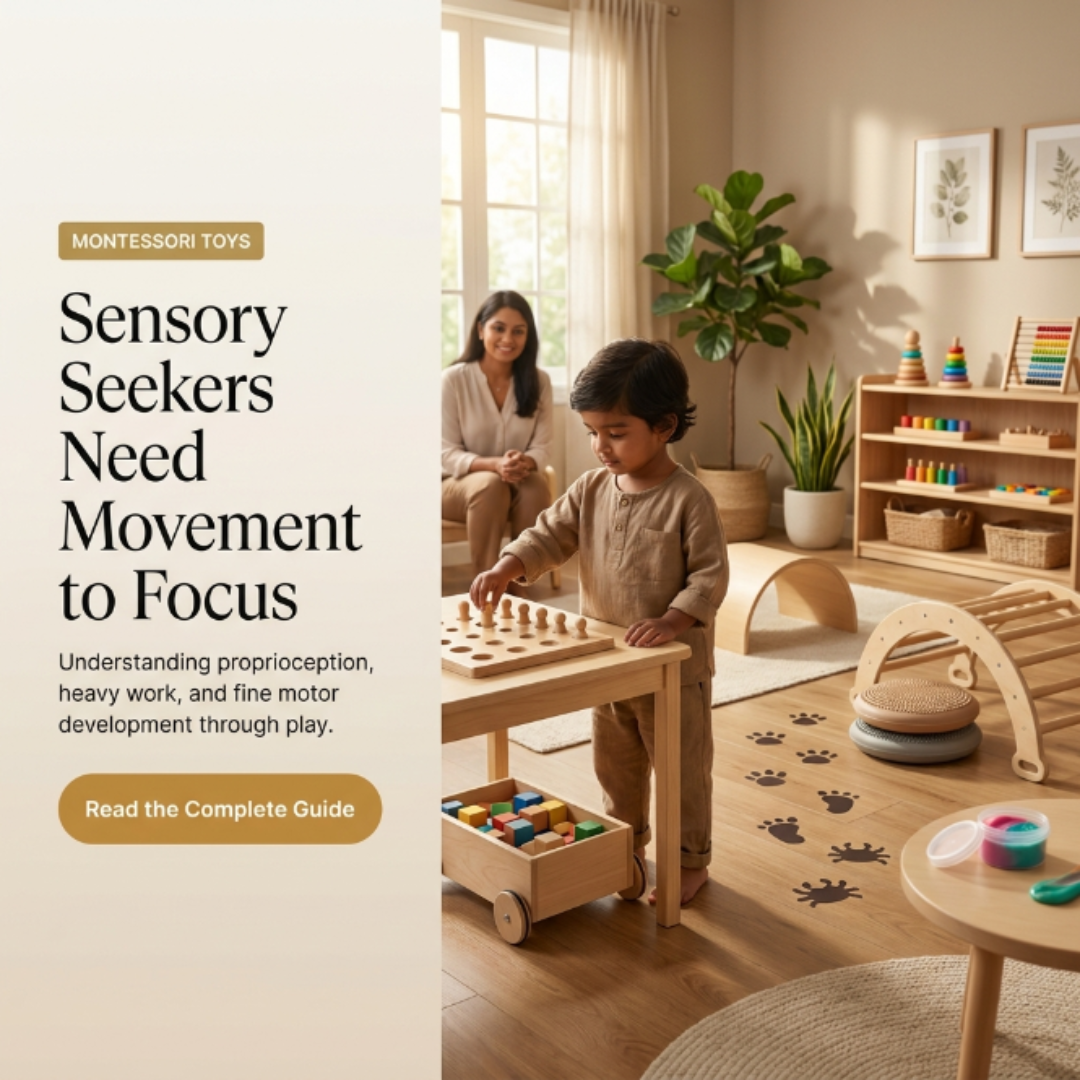
Heavy work refers to activities that push, pull, lift, or carry against resistance, providing the deep proprioceptive input a sensory seeking nervous system needs to settle. Occupational therapists frequently recommend heavy work immediately before any task requiring focus or fine control, since it helps regulate the nervous system first rather than fighting against it.
A range of heavy work and proprioceptive activities are commonly used in occupational therapy practice, and many translate easily to home use:
- Weight-bearing movement like crawling or wall push-ups, which engage large muscle groups against resistance
- Carrying heavy objects, like a laundry basket, backpack with books, or bag of groceries, across a room
- Animal walks such as bear crawls, crab walks, or frog jumps, which combine gross motor effort with proprioceptive feedback
- Pushing and pulling activities, like pushing a loaded laundry basket or playing tug of war
- Squeezing therapy putty, a stress ball, or Play-Doh, which provides proprioceptive input directly through the hands
- Rhythmic, sustained activity like walking briskly for a stretch of time, which provides steady, predictable proprioceptive input
The goal is not to tire the child out, but to give the nervous system the input it is seeking so that a calmer, more focused state follows naturally, rather than being forced.
A Real Sensory Diet Schedule From Occupational Therapy Practice
Seeing an actual example makes the concept far more concrete. Below is a real sensory diet structure used for a child named Adam in an early years setting, documented by occupational therapy guidance, showing how movement and focused tasks are deliberately alternated rather than separated into "playtime" and "work time":
| Time | Activity |
|---|---|
| 9:00 | Free play with room to run, followed by 5 minutes of wind-down with soft music, dim lights, and deep-pressure massage |
| 9:20 | Seated choosing activity with a support person |
| 9:30 | Circle time and story, with built-in movement tasks like fetching the book or turning pages so sitting never exceeds 10 minutes |
| 10:00 | Active play in the corridor, ball games or bean-bag toss |
| 10:15 | Seated snack time |
| 10:30 | Standing stretches, then a seated focused task |
| 11:00 | Outdoor playtime with room to run, jump, and climb |
Notice that no single seated period exceeds around 10 to 15 minutes, and every calm task is bracketed by movement on both sides. This structure, not any single activity, is what actually works for sensory seeking children, and it maps directly onto how you can sequence fine motor practice at home.
How Therapists Actually Combine Sensory Input With Fine Motor Tasks
Pediatric occupational therapy sessions rarely treat sensory regulation and fine motor practice as separate goals, they are woven together in the same activity. In one documented pediatric OT session, a therapist working with a child who showed sensory seeking behavior and immature grasp patterns used weighted wrist and ankle bands to give the child a better sense of her body in space, then incorporated resistive tools like therapy putty, tongs, and tweezers to build hand strength and grasp control at the same time.
To add proprioceptive challenge directly into the fine motor task, the therapist had the child sustain her grasp on an object while carrying it along an obstacle course, turning a simple carrying task into both a strength challenge and a motivating game. Reaching across the body's midline was also deliberately built into games, since this helps integrate the left and right sides of the body and supports the trunk control that stabilizes the hands during fine motor work. Sessions consistently ended with calming, organizing input, dim lighting, slow rhythmic swinging, and breathing activities, to help the child's nervous system settle after the more stimulating movement work.
This is a genuinely useful blueprint for home use: pair a fine motor task with a small proprioceptive challenge, like carrying a peg-filled container across the room before sitting down to place the pegs, rather than treating movement and fine motor practice as competing priorities.
Building a Simple Sensory-Fine Motor Routine at Home
Rather than treating sensory needs and fine motor practice as two separate activities competing for time, they can be sequenced together into one short, effective routine, mirroring the structure used in real sensory diets:
- 2 to 3 minutes of heavy work, like wall push-ups, animal walks, or carrying a weighted basket
- Immediately offer the fine motor task, like a peg board or lacing toy, while the regulating effect is still active
- Expect 1 to 3 minutes of genuine engagement, which is a realistic and valuable outcome, not a failure
- End with a brief calming activity, like a firm hug or a minute of quiet rocking, mirroring how OT sessions close with organizing input
- Repeat the full sequence 2 to 4 times across the day rather than expecting one long session
This approach respects the sensory need instead of treating it as an obstacle to work around, which tends to produce far more consistent engagement than repeatedly trying to convince a dysregulated child to sit still.
Fine Motor Tools That Work Well for Sensory Seekers
Certain toy features make a real difference for sensory seeking children specifically, beyond the general movement-friendly setups covered for active kids more broadly:
- Weighted or heavier pegs: The added resistance during grasp and placement provides a small amount of proprioceptive feedback with each repetition, similar in principle to the weighted bands used in clinical OT sessions
- Textured surfaces: Wooden peg boards with a slightly grippy, textured feel give more tactile feedback than very smooth plastic, which some sensory seekers find more satisfying to interact with
- Resistive tools like tongs and tweezers: Occupational therapists use these specifically to build hand strength and proprioceptive feedback alongside grasp control
- Therapy putty or Play-Doh warm-ups: Squeezing dense putty before a peg board session gives the hands proprioceptive input that can make the subsequent fine motor task easier to sustain
- Tasks with a clear physical end point: A board with a fixed number of holes gives a natural stopping point, which some sensory seekers find easier to complete than open-ended tasks
Give sensory seekers a fine motor toy with real tactile feedback. Our Educational Peg Boards feature a sturdy wooden base and firm, textured pegs that provide the grip resistance sensory seeking children often respond well to.
Shop Educational Peg Boards Find Us on Google Business ProfileSensory Seeker or Just an Active Toddler?
Most toddlers show some sensory seeking behaviors occasionally, so the distinction is really about intensity, consistency, and impact rather than a single behavior. A few patterns can help you tell the difference:
| Typically Active Toddler | Likely Sensory Seeker |
|---|---|
| Can settle with an interesting or novel activity | Remains restless even with genuinely engaging activities |
| Movement need varies by time of day and energy level | Movement-seeking is fairly constant across most of the day |
| Occasional rough play or crashing into things | Frequent, intense crashing, jumping, or deep pressure seeking daily |
| Responds well to short movement breaks | Needs heavy work specifically, light movement breaks are not enough |
This is a general pattern, not a diagnostic tool, but it can help you decide whether the general movement-friendly strategies covered elsewhere are enough, or whether adding dedicated heavy work and proprioceptive input is worth trying.
When to Seek Professional Support
Occasional sensory seeking behavior is common and does not require professional intervention on its own. It becomes worth discussing with a pediatrician or occupational therapist if sensory seeking behaviors are intense enough to interfere with daily routines, if your child cannot engage with any calm task even briefly despite heavy work strategies, or if sensory seeking is paired with other developmental concerns like delayed speech or significant fine motor delays.
An occupational therapist can assess whether a child's sensory profile falls within typical variation or reflects a sensory processing difference that would benefit from a formal, individualized sensory diet designed and monitored by a professional.
Frequently Asked Questions
What is a sensory seeker in child development terms?
A sensory seeker is a child whose nervous system under-registers certain sensory input, particularly movement and proprioceptive input, leading them to actively seek out more of it through constant movement, crashing, or intense physical play.
What is a sensory diet?
A sensory diet is a structured plan of individualized sensory activities delivered at specific times throughout the day to help a child stay regulated enough to participate in daily tasks, similar to how meals are spaced out to maintain steady energy.
Why do sensory seekers struggle with fine motor tasks?
Fine motor tasks require calm, controlled, low-intensity movement, which runs counter to what a sensory seeking nervous system is craving, making it hard to sustain focus without addressing the underlying movement need first.
What is heavy work and how does it help?
Heavy work refers to activities that push, pull, lift, or carry against resistance, such as carrying a laundry basket or doing wall push-ups, providing deep proprioceptive input that helps regulate a sensory seeking nervous system before a task requiring focus.
How is a sensory seeker different from a typically active toddler?
A sensory seeker's need for movement is fairly constant regardless of activity or time of day and often involves intense behaviors like crashing or deep pressure seeking, while a typically active toddler's energy varies more and responds to novelty or short movement breaks.
When should I see a professional about sensory seeking behavior?
It is worth discussing with a pediatrician or occupational therapist if sensory seeking behaviors interfere with daily routines, do not improve with heavy work strategies, or occur alongside other developmental concerns.
Related reading:
- Fine Motor Activities for Kids Who Refuse to Sit Still
- Fine Motor Skills in Toddlers: The Complete Guide for Parents
- How to Tell If Your Toddler Is Behind on Fine Motor Development
- Occupational Therapists on Peg Boards: What They Actually Recommend and Why
- 5 Signs Your Child Is Ready for a Peg Board
Ready to try a fine motor toy built for real tactile feedback? Browse our peg board collection, designed with sturdy, textured pegs that give sensory seekers something satisfying to grip.
Shop Educational Peg Boards Visit Our Google Business ProfileMontessori Toys Team
We research child development guidelines to help parents choose toys that genuinely support learning at every stage.