

By Montessori Toys · Updated July 2026 · 17 min read
Hand-Eye Coordination in Children: How Visual-Motor Integration Develops from Birth to Age 6
In this guide:
- What hand-eye coordination actually means
- The five developmental stages
- The complete age-by-age timeline
- Why this ties every skill in this series together
- Signs a child struggles with visual-motor skills
- Activities that build hand-eye coordination
- When to seek professional support
- Frequently asked questions
Throughout this series, we have covered hand dominance, crossing the midline, and in-hand manipulation as separate skills. But there is one system that ties all of them together behind the scenes, the coordination between what a child's eyes see and what their hands are able to do about it. Without strong hand-eye coordination, none of the other fine motor skills we have discussed can fully come together in real-world tasks like writing, catching, or cutting.
What Hand-Eye Coordination Actually Means
Hand-eye coordination, also known as visual-motor integration, is the skill that emerges from combining visual skills, visual perceptual skills, and motor skills, allowing the eyes and hands to work together in a coordinated, efficient way . Visual-motor control specifically involves interpreting visual stimuli and reproducing it through an appropriate motor output, which is why it matters for tasks like copying from a board or catching a moving ball
Everyday activities like building with blocks, scribbling, tracing, writing, drawing, cutting, and catching a ball are all examples of hand-eye coordination in action This makes it one of the most practically important skills in this entire series, since it shows up in almost every task a child performs during the day.
The Five Developmental Stages
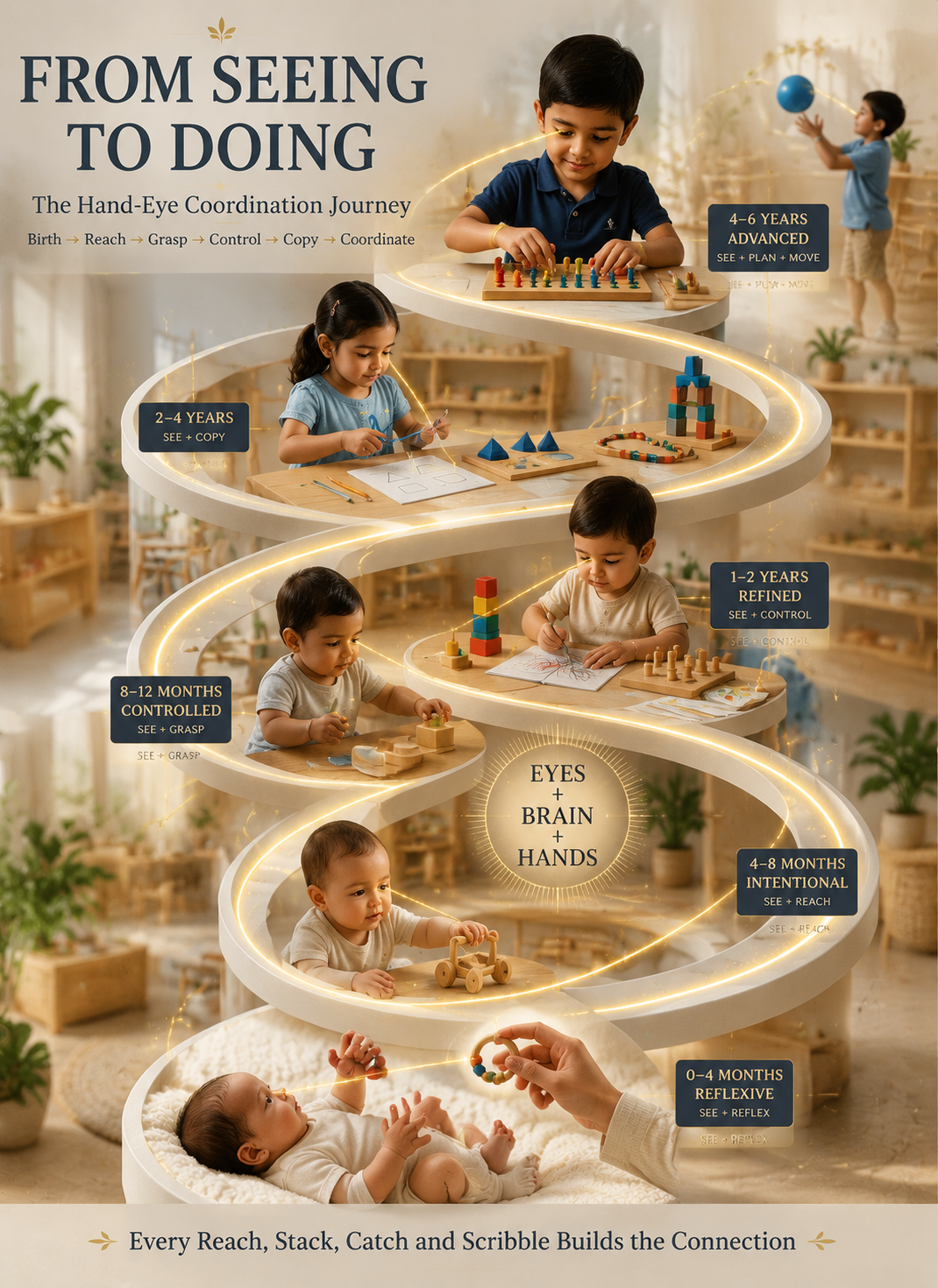
Hand-eye coordination develops through five broad, sequential stages, each building on the skills of the one before it
- Reflexive stage (0 to 4 months): Infants develop basic, instinctual grasping reflexes when an object is placed in their hand, laying the groundwork for later intentional movement
- Intentional stage (4 to 8 months): Infants begin purposefully reaching for objects, visually tracking them, and starting to understand cause and effect
- Controlled stage (8 to 12 months): Infants refine their movements, gaining precision, transferring objects hand to hand, and developing the pincer grasp
- Refined stage (1 to 2 years): Toddlers stack blocks, turn book pages, and scribble with crayons, with visual tracking becoming noticeably more accurate
- Advanced stage (2 to 6 years): Children catch and throw a ball, draw basic shapes, and use scissors, showing improved dexterity for intricate, precise tasks
The Complete Age-by-Age Timeline
| Age | Milestone |
|---|---|
| 0 to 3 months | Visually follows moving objects, begins reaching, hands start opening more |
| 3 to 6 months | Watches own hands during play, swipes at objects in view, holds small objects |
| 4 to 6 months | May grab objects but drop them unintentionally, grabs and plays with own feet |
| 6 months | Sights and reaches for an object without repeatedly looking back at the hand |
| 12 to 15 months | Pincer grasp develops, allowing accurate sighting and grasping of small objects |
| 15 to 18 months | Stacks two to three blocks, strings large beads, turns book pages |
| 4 years | Handles eating utensils well, buttons small buttons, holds a pencil competently, copies shapes |
| 5 years | Approaches, grasps, and releases objects with precision, completes familiar puzzles quickly, ties shoelaces |
| 5 to 7 years | Colors within lines, does and undoes buttons independently, begins playing sport |
| 9 years | Eyes and hands work well independently of each other, can use tools like garden equipment and complete simple sewing |
Why This Ties Every Skill in This Series Together
Hand-eye coordination is not a standalone skill sitting apart from everything else we have covered, it is the visual guidance system that makes those other skills usable in real tasks. In-hand manipulation depends on the eyes accurately guiding the fingers to rotate or shift an object into the right position, and crossing the midline depends partly on the eyes tracking smoothly across that same line to guide the hand
Even hand dominance benefits from good visual-motor integration, since a child needs to visually judge distance and direction accurately before their preferred hand can reach precisely and reliably. This is why occupational therapists rarely treat hand-eye coordination in isolation, it interacts constantly with the other systems already discussed in this series.
Signs a Child Struggles With Visual-Motor Skills
- Frequently missing or misjudging distance when reaching for, throwing, or catching objects
- Difficulty copying shapes, letters, or patterns accurately from a book or board
- Coloring or writing that consistently strays outside lines well past the age this is expected
- Clumsiness with tools or objects that require watching and moving the hand simultaneously, like scissors or a fork
Activities That Build Hand-Eye Coordination
Occupational therapy guidance highlights a range of engaging, low-pressure activities for building visual-motor integration at different ages:
- Copying games: Simon Says, mirror games, and follow-the-leader all require watching a model and reproducing it with the body or hands
- Bead and block patterns: Copying card patterns using threading beads, or recreating block designs like bridges and towers
- Catch with varied balls: Playing catch with bean bags, bouncy balls, or beach balls of different sizes and weights to build adaptable visual judgment
- Drawing and copying lines: Copying pre-drawn vertical, horizontal, and angled lines, progressing gradually to shapes and letters
- Peg board patterns: Using a peg board to create a pattern for a child to recreate, directly linking visual perception with fine motor placement
Strengthen hand-eye coordination through pattern-based play. Our Educational Peg Boards are specifically recommended for creating and recreating patterns, directly linking what a child sees with precise hand placement.
Shop Educational Peg Boards Find Us on Google Business ProfileWhen to Seek Professional Support
Some variability in hand-eye coordination is expected at every age, since these skills continue refining through age 9 and beyond. It is worth consulting an occupational therapist if a child well past the expected age still shows significant difficulty catching, copying shapes accurately, coloring within lines, or completing tasks that require watching and moving the hand at the same time.
An occupational therapist can determine whether the underlying gap is in visual perception, motor control, or the integration between the two, and can build a targeted plan rather than generic practice.
Frequently Asked Questions
What is hand-eye coordination?
Hand-eye coordination, or visual-motor integration, is the ability to combine visual perception with motor skills so the eyes and hands work together accurately, guiding tasks like catching, writing, and cutting.
What are the stages of hand-eye coordination development?
Development moves through five stages: reflexive (0 to 4 months), intentional (4 to 8 months), controlled (8 to 12 months), refined (1 to 2 years), and advanced (2 to 6 years).
At what age can a child color within the lines?
Most children develop the precision to color within lines and manage buttons independently between age 5 and 7, as hand-eye coordination becomes more refined.
How does hand-eye coordination relate to other fine motor skills?
It acts as the visual guidance system behind in-hand manipulation, midline crossing, and hand dominance, letting the eyes accurately direct precise hand movement across all these skills.
What activities build hand-eye coordination?
Copying games like Simon Says, bead and block patterns, catch with varied ball sizes, line copying, and peg board patterns all strengthen the connection between vision and motor control.
When should I be concerned about hand-eye coordination delays?
Consult an occupational therapist if a child well past the expected age still struggles significantly with catching, copying shapes, or tasks requiring simultaneous watching and hand movement.
Related reading:
- Hand Dominance in Children: When It Develops and Why You Shouldn't Choose
- Crossing the Midline in Children: Why It Matters for Writing and Coordination
- Tactile Sensitivity and Fine Motor Skills: Helping Kids Who Avoid or Crave Touch
- Sensory-Friendly Fine Motor Routine: Daily Activities That Help Kids Focus
- Vestibular Input and Fine Motor Skills: Helping Active Kids Focus Through Movement
- Sensory Seekers and Fine Motor Skills: Helping Kids Focus Through Movement
- Fine Motor Milestones Birth to Age 5: Complete Development Chart
Ready to strengthen the visual-motor connection through play? Browse our peg board collection, ideal for pattern copying and precise hand placement.
Shop Educational Peg Boards Visit Our Google Business ProfileMontessori Toys Team
We research child development guidelines to help parents choose toys that genuinely support learning at every stage.