

By Montessori Toys · Updated July 2026 · 17 min read
Scissor Skills by Age: The Complete Development Timeline and Readiness Checklist
In this guide:
- Is my child ready for scissors?
- Stage 1: holding and snipping (18 months to 2.5 years)
- Stage 2: cutting across paper (2.5 to 3.5 years)
- Stage 3: cutting lines and curves (3.5 to 4.5 years)
- Stage 4: cutting shapes (4.5 to 5 years)
- Stage 5: complex shapes and mature control (5 to 7 years)
- The complete scissor skills chart
- Why the "helping hand" matters as much as the cutting hand
- Common cutting problems and what they mean
- Pre-scissor activities that build the right foundation
- When to seek professional support
- Frequently asked questions
Handing a child their first pair of scissors is a milestone every parent remembers, but knowing when and how to introduce them takes more than guesswork. Scissor skills follow a well-documented developmental sequence, and understanding each stage helps you set realistic expectations and pick the right activities rather than pushing a skill before the underlying strength and coordination are ready.
Is My Child Ready for Scissors?
Readiness for scissors depends on several underlying skills working together, not simply reaching a certain birthday. According to pediatric development guidance, a child is generally ready to start practicing with scissors when they show the following signs
- Enough balance and core strength to stay upright while sitting
- Good hand and arm strength and control
- A mature pincer grasp
- The ability to use both sides of the body together, known as bilateral coordination
- The ability to understand and follow simple instructions
- Interest in coloring and simple craft activities [
Most children show these signs somewhere between 18 months and 2.5 years, but this range varies considerably, and a child missing one or two of these signs simply needs more foundational practice before scissors, not necessarily more scissor practice itself.
Stage 1: Holding and Snipping (18 Months to 2.5 Years)
The very first stage of scissor development is simply learning to hold the scissors and operate the mechanism, generally emerging between 18 months and 2 years At this point, children typically use both hands together just to open and close the blades, since the hand strength required to operate scissors with one hand has not yet developed .
Around age 2, most children can make a single snip in paper or playdough, cutting one small bite at a time rather than moving forward continuously along a line. This is the appropriate stage to introduce safety scissors with soft materials like playdough or modeling clay, since it removes the pressure of producing an accurate cut while the child is still learning basic hand mechanics
Stage 2: Cutting Across Paper (2.5 to 3.5 Years)
By around 2.5 years, children generally progress from single snips to cutting all the way across a short strip of paper, commonly measured as a 6-inch piece. This requires the child to coordinate a continuous series of snips rather than a single isolated cut, an important step toward controlled, forward-moving cutting.
Between 3 and 3.5 years, most children can cut along a line roughly 6 inches long, and this is also the stage where the non-dominant hand, called the helping hand, begins to actively hold and rotate the paper to assist the cutting hand. This bilateral coordination piece is a major developmental leap, since it requires each hand to perform a different, coordinated job at the same time.
Stage 3: Cutting Lines and Curves (3.5 to 4.5 Years)
Between 3.5 and 4 years, children typically gain the ability to cut out a circle, though accuracy is still developing, starting around half an inch from the intended line and gradually improving to a quarter inch as practice continues By age 4, most children can cut forward along a straight line roughly 10cm long and about half a centimeter thick, and can cut along a similarly thick curved line, generally after watching a demonstration first
This stage represents a meaningful jump in precision, moving from simply cutting forward to actually following a visual target, which requires much closer coordination between the eyes and the cutting hand than earlier stages demanded.
Stage 4: Cutting Shapes (4.5 to 5 Years)
Around age 4.5 to 5, most children can cut out a square shape with reasonable accuracy, generally staying within about a quarter inch of the intended line. Straight-edged shapes like squares and triangles tend to emerge before more complex curved shapes, since corners require a controlled stop-and-turn motion that is easier to coordinate than a continuous curve
Control over the scissors themselves also improves noticeably during this stage, producing smoother, less jagged cutting lines compared to the somewhat rough edges typical of earlier stages
Stage 5: Complex Shapes and Mature Control (5 to 7 Years)
By age 5 to 6, and continuing to mature through age 7, children generally progress to cutting a wide variety of more complex shapes, including figures, animals, and detailed craft pieces At this stage, the coordination between the cutting hand and the helping hand has become consistent and largely automatic, and most cuts are smooth, without the jagged edges or accidental tears common at earlier stages
This represents the functional endpoint of scissor development for most everyday and school-based tasks, though continued practice through the early primary school years further refines precision and speed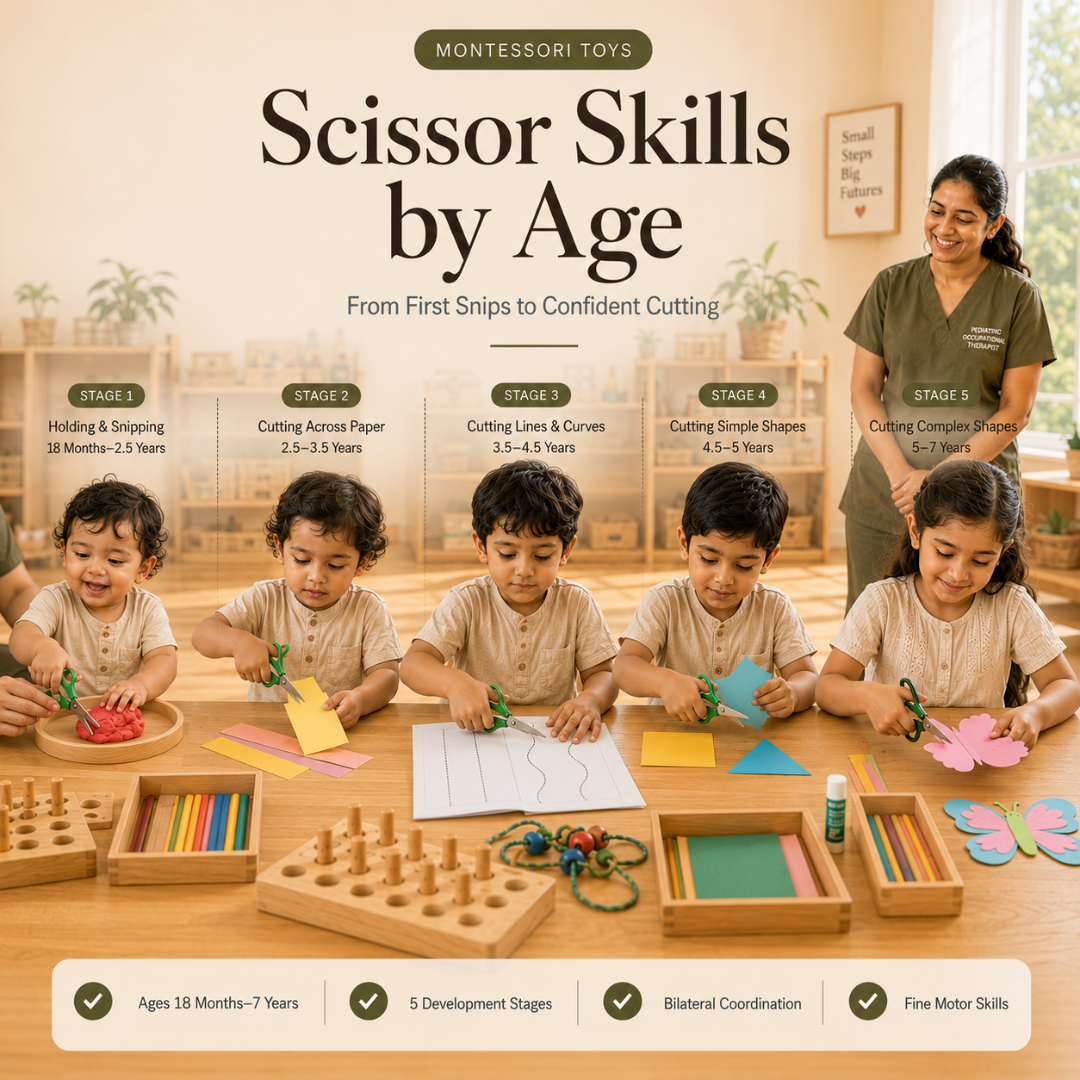
The Complete Scissor Skills Chart
| Age | Typical Skill |
|---|---|
| 18 months to 2 years | Holds scissors, opens and closes with both hands |
| 2 years | Makes single snips in paper or playdough |
| 2.5 years | Cuts across a 6-inch piece of paper |
| 3 to 3.5 years | Cuts on a 6-inch line, helping hand begins assisting |
| 3.5 to 4 years | Cuts out a circle with improving accuracy |
| 4 to 4.5 years | Cuts straight and curved lines after demonstration |
| 4.5 to 5 years | Cuts out a square and triangle |
| 5 to 7 years | Cuts complex shapes with smooth, consistent control |
As with pencil grasp development covered in our companion guide, these ages represent typical ranges rather than fixed deadlines, and individual variation is completely normal.
Why the "Helping Hand" Matters as Much as the Cutting Hand
It is easy to focus entirely on the hand holding the scissors, but the non-dominant hand plays an equally important role, holding and rotating the paper so the cutting hand can follow a line or curve. This coordinated two-hand task is known as bilateral coordination, and it is one of the specific readiness signs identified before scissors are introduced at all
When a child struggles with cutting, the problem is not always the cutting hand's grip or strength, it is frequently the helping hand failing to rotate the paper at the right time or in the right direction, especially around curves and corners. Practicing bilateral coordination through non-scissor activities can meaningfully improve cutting skill even without more scissor practice itself.
Common Cutting Problems and What They Mean
| Observed Problem | Likely Underlying Cause |
|---|---|
| Cuts are jagged or torn rather than smooth | Limited hand strength, still developing at this stage |
| Cutting veers consistently off the line | Helping hand not rotating paper to follow the cutting hand |
| Child opens and closes scissors with the whole hand rather than fingers | Still in an earlier stage than expected for age, needs more grip practice |
| Child avoids scissors or tires very quickly | Underlying hand strength or grip endurance may need building first |
Pre-Scissor Activities That Build the Right Foundation
Rather than jumping straight into scissors, occupational therapy guidance often recommends a stage of pre-scissor skill building focused on hand strength, pincer grasp, and bilateral coordination. Activities that build these same skills include:
- Peg boards and lacing toys, which build the pincer grasp strength scissors require
- Tearing paper by hand, which builds finger strength and bilateral hand use without the mechanical complexity of scissors
- Squeezing tongs or clothespins, which strengthens the exact finger muscles used to open and close scissor blades
- Two-handed tasks like holding a bowl while stirring, which builds the bilateral coordination scissors depend on
Build the pincer grasp and bilateral coordination scissors depend on. Our Educational Peg Boards target the exact hand strength and two-handed coordination that make scissor practice easier once your child is ready.
Shop Educational Peg Boards Find Us on Google Business ProfileWhen to Seek Professional Support
Some variation in scissor skill timing is completely normal, and slower progress at any one stage does not automatically indicate a problem. It is worth consulting an occupational therapist if a child well past the expected age range for a stage still cannot snip paper at all, consistently avoids scissors despite repeated low-pressure exposure, or shows significant difficulty with bilateral coordination across multiple activities, not just cutting.
An occupational therapist can assess whether the underlying strength, grasp, or coordination skills scissors depend on are developing as expected, and can design targeted pre-scissor activities if a gap is identified.
Frequently Asked Questions
At what age should a child start using scissors?
Most children are ready to begin holding and practicing with safety scissors between 18 months and 2.5 years, though actual controlled cutting develops gradually over the following years.
What are the signs my child is ready for scissors?
Key readiness signs include core strength to sit upright, hand and arm control, a mature pincer grasp, bilateral coordination, understanding simple instructions, and interest in craft activities.
When can a child cut out a circle or square?
Most children can cut out a circle with reasonable accuracy around 3.5 to 4 years, and a square around 4.5 to 5 years, with straight-edged shapes generally emerging before complex curves.
Why does my child's helping hand matter for cutting?
The non-dominant helping hand holds and rotates the paper so the cutting hand can follow a line or curve, and difficulty here is a common but overlooked cause of jagged or inaccurate cuts.
What should I do before introducing scissors?
Building pincer grasp strength and bilateral coordination through activities like peg boards, tearing paper, and using tongs can make scissor practice significantly easier once introduced.
When should I be concerned about scissor skill delays?
It is worth consulting an occupational therapist if a child is well past the expected age for a stage and still cannot snip paper, consistently avoids scissors, or shows broader bilateral coordination difficulties.
Related reading:
- Tactile Sensitivity and Fine Motor Skills: Helping Kids Who Avoid or Crave Touch
- Sensory-Friendly Fine Motor Routine: Daily Activities That Help Kids Focus
- Vestibular Input and Fine Motor Skills: Helping Active Kids Focus Through Movement
- Sensory Seekers and Fine Motor Skills: Helping Kids Focus Through Movement
- Fine Motor Milestones Birth to Age 5: Complete Development Chart
Ready to build the hand strength your child needs before scissors? Browse our peg board collection, designed to strengthen pincer grasp and bilateral coordination.
Shop Educational Peg Boards Visit Our Google Business ProfileMontessori Toys Team
We research child development guidelines to help parents choose toys that genuinely support learning at every stage.