
By Montessori Toys · Updated July 2026 · 17 min read
Bilateral Coordination: The Foundation Skill Behind Hand Dominance, Midline Crossing, and Hand-Eye Coordination
In this guide:
- What bilateral coordination actually means
- The three bilateral movement patterns
- The complete age-by-age timeline
- Why this is the foundation for everything else in this series
- Signs a child struggles with bilateral coordination
- Activities that build bilateral coordination
- When to seek professional support
- Frequently asked questions
This series has walked through hand dominance, crossing the midline, in-hand manipulation, and hand-eye coordination as though they were separate skills developing independently of one another. In reality, all four sit on top of one single foundation, the ability to use both sides of the body together in a coordinated way. This is bilateral coordination, and understanding it ties every earlier post in this series together.
What Bilateral Coordination Actually Means
Bilateral coordination is the ability to use both sides of the body together in a coordinated and efficient way, and it is crucial for daily tasks, sports participation, and fine motor precision Children with strong bilateral coordination can balance, catch, throw, write, and manipulate objects more effectively, since so many everyday actions require the two sides of the body to cooperate rather than work in isolation.
This skill develops in clear, sequential stages throughout the first several years of a child's life, rather than emerging all at once . Each stage represents a more sophisticated way for the two sides of the body to work together, and children generally move through them in the same order, though at their own individual pace.
The Three Bilateral Movement Patterns
Bilateral coordination breaks down into three distinct patterns, and children typically develop them in this order:
- Symmetrical bilateral integration: Both hands and arms move together doing the exact same job at the same time, such as catching a large ball with two hands or rolling out dough with a rolling pin
- Alternating (reciprocal) patterns: The two sides of the body move in a rhythmic, alternating sequence, such as crawling, walking, or pedaling a tricycle
- Asymmetrical bilateral integration: The two hands perform different jobs simultaneously, one hand stabilizes while the other actively manipulates, such as holding paper still while cutting with scissors, or holding a bowl while stirring with the other hand
Asymmetrical coordination is considered the most advanced of the three patterns, since it requires each hand to perform a genuinely different task while still working as a coordinated team]. This is exactly the pattern behind the scissor skills, dressing, and in-hand manipulation tasks covered earlier in this series.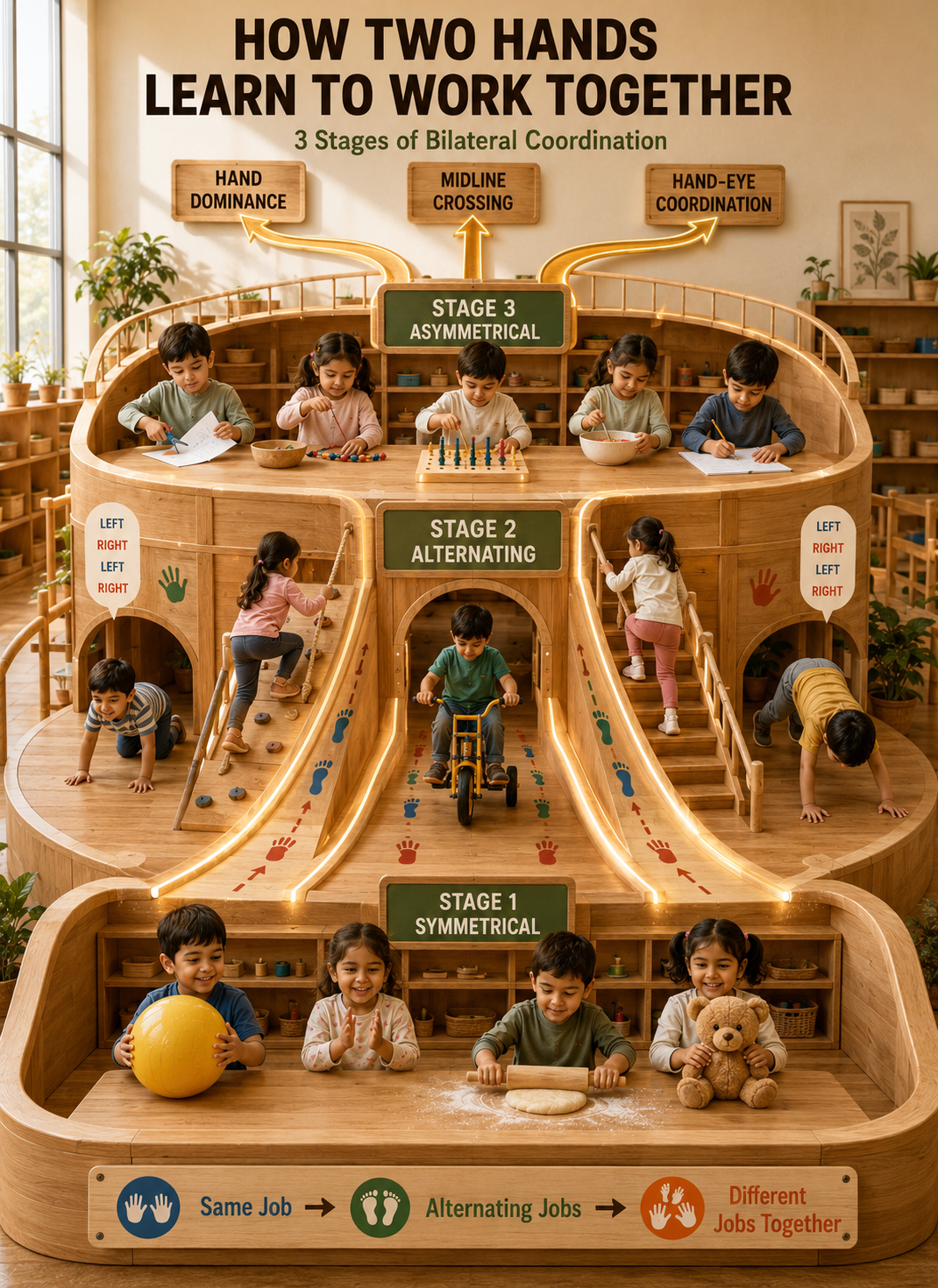
The Complete Age-by-Age Timeline
| Age | Milestone |
|---|---|
| 6 to 12 months | Holds and carries a large ball with both hands |
| 9 to 10 months | Holds an object in each hand and bangs them together |
| 10 months | Holds an object in one hand while the other hand manipulates it |
| 17 to 18 months | Stabilizes an object in one hand while activating or manipulating it with the other, using both hands for different actions simultaneously |
| 2 years | Throws a ball forward while maintaining balance, stabilizes a dish during spoon-feeding, begins pedaling a tricycle |
| 3 years | Cuts on a line, stabilizes paper during coloring or writing, holds paper while cutting, catches a medium ball |
| 4 years | Cuts simple shapes, walks up and down stairs alternating feet, catches a tennis ball |
| 5 years | Throws a ball overhand to hit a target about 5 feet away |
| 6+ years | Complex cutting skills, manipulating paper during cutting, throwing a ball accurately over 12 feet, cutting with a fork and knife |
Bilateral coordination typically begins around 18 to 24 months and is usually well established by around age 4, though refinement continues well beyond that
Why This Is the Foundation for Everything Else in This Series
Children progress through bilateral coordination in a specific order, first coordinating both sides of the body for the same action, then for opposite actions like crawling, and finally, using a leading hand and a supporting hand together this final stage is precisely where hand dominance comes from, between 2 and 4 years, children start showing a hand preference while still using both hands for different tasks, and by 4 to 6 years, one hand becomes dominant for fine motor tasks like writing while the other becomes the helper
Crossing the midline is really just bilateral coordination applied across the body's centerline, and hand-eye coordination depends on the same asymmetrical bilateral pattern to stabilize an object with one hand while the eyes guide the other hand's precise movement. In other words, every skill covered earlier in this series is a specific application of bilateral coordination, not a separate system entirely.
Signs a Child Struggles With Bilateral Coordination
- Difficulty stabilizing paper while cutting or writing, letting it slide around instead of holding it steady
- Avoiding two-handed tasks like catching a large ball or using a rolling pin
- Struggling with alternating movement patterns like climbing stairs foot over foot, or pedaling a tricycle smoothly Noticeable delay in developing a stabilizing "helper hand" alongside an active hand during two-handed tasks
Activities That Build Bilateral Coordination
| Pattern | Activity |
|---|---|
| Symmetrical | Clapping games, jumping jacks, rolling a ball back and forth, using a rolling pin |
| Alternating | Climbing, crawling through obstacle courses, riding a bike, animal walks |
| Asymmetrical | Stringing beads with one hand holding the string, cutting shapes, building with blocks, peg boards |
Build the foundation skill behind everything in this series. Our Educational Peg Boards are a classic asymmetrical bilateral coordination activity, one hand stabilizes the board while the other precisely places each peg.
Shop Educational Peg Boards Find Us on Google Business ProfileWhen to Seek Professional Support
Some early difficulty with bilateral coordination is expected, since the skill continues developing through age 6 and beyond. It is worth consulting an occupational therapist if a child well past age 4 still avoids two-handed tasks, cannot stabilize paper while cutting or writing, or struggles significantly more than peers with alternating movement patterns like stair climbing or pedaling.
An occupational therapist can identify exactly which pattern, symmetrical, alternating, or asymmetrical, needs the most support, and can design activities that build that specific stage before moving to the next.
Frequently Asked Questions
What is bilateral coordination?
Bilateral coordination is the ability to use both sides of the body together in an organized, efficient way, and it underlies tasks ranging from catching a ball to writing and cutting with scissors.
What are the three types of bilateral coordination?
The three patterns are symmetrical, both hands doing the same job at once, alternating, the two sides moving in rhythmic sequence, and asymmetrical, one hand stabilizing while the other actively works.
At what age does bilateral coordination develop?
It typically begins around 18 to 24 months and is generally well established by age 4, though refinement of more complex tasks continues through age 6 and beyond.
How does bilateral coordination relate to hand dominance?
Hand dominance emerges directly from the asymmetrical bilateral coordination stage, where a child begins using one hand as the active, leading hand and the other as a stabilizing helper.
What activities build bilateral coordination?
Clapping games and rolling pins build symmetrical coordination, climbing and biking build alternating coordination, and stringing beads or peg boards build asymmetrical coordination.
When should I be concerned about bilateral coordination delays?
Consult an occupational therapist if a child well past age 4 still avoids two-handed tasks, cannot stabilize paper while cutting, or struggles significantly with alternating movements like stair climbing.
Related reading:
- Hand-Eye Coordination in Children: Visual-Motor Development by Age
- Hand Dominance in Children: When It Develops and Why You Shouldn't Choose
- Crossing the Midline in Children: Why It Matters for Writing and Coordination
- Tactile Sensitivity and Fine Motor Skills: Helping Kids Who Avoid or Crave Touch
- Sensory-Friendly Fine Motor Routine: Daily Activities That Help Kids Focus
- Vestibular Input and Fine Motor Skills: Helping Active Kids Focus Through Movement
- Sensory Seekers and Fine Motor Skills: Helping Kids Focus Through Movement
- Fine Motor Milestones Birth to Age 5: Complete Development Chart
Ready to build the foundation skill behind every fine motor milestone? Browse our peg board collection, ideal for practicing asymmetrical bilateral coordination.
Shop Educational Peg Boards Visit Our Google Business ProfileMontessori Toys Team
We research child development guidelines to help parents choose toys that genuinely support learning at every stage.