

By Montessori Toys · Updated July 2026 · 17 min read
Hand Dominance in Children: When It Develops and Why You Should Never Choose for Your Child
In this guide:
- What hand dominance actually means
- The typical hand dominance timeline
- Why dominance starts with two-handed play, not one
- The golden rule: never choose a hand for your child
- Mixed dominance vs true ambidexterity
- How to observe hand preference without influencing it
- Activities that support dominance development
- Why the assisting hand matters just as much
- When to seek professional support
- Frequently asked questions
If you have been following our scissor skills and pencil grasp guides, you may have noticed something else going on alongside those milestones, your child switching the pencil or scissors from hand to hand without any clear pattern. This is one of the most common questions parents ask, and also one of the most misunderstood, because the instinct to "help" a child settle on a hand is exactly the wrong move at the wrong time.
What Hand Dominance Actually Means
Hand dominance, also called hand preference, is the consistent preference for one hand over the other to perform fine and gross motor tasks, such as writing, cutting, or throwing a ball . It describes not just which hand a child reaches for first, but which hand is consistently more skilled and controlled at these tasks compared to the other
Establishing hand dominance is not a minor preference, it is considered a necessary foundation for developing fine motor skills, including handwriting. This is why occupational therapists pay close attention to how and when this preference emerges, rather than treating it as incidental.
The Typical Hand Dominance Timeline
Hand preference follows a broad, well-documented developmental window, though the exact ages vary somewhat between sources:
- Age 2 to 4: Early signs of hand preference begin emerging, though switching hands is still very common and expected during this window
- Age 4 to 6: Most children develop a clear, established hand preference, and by kindergarten most are showing a consistent dominant hand
- Age 5 to 7: Some sources place full, consistent dominance slightly later in this range rather than by age 6
- Up to age 8 or 9: In some children, hand preference continues to solidify even later, and this still falls within documented developmental variation
This means a 3-year-old switching hands constantly is showing entirely typical development, while a child in kindergarten still switching should simply be watched a little more closely rather than immediately treated as a concern
Why Dominance Starts With Two-Handed Play, Not One
A detail that surprises many parents is that hand dominance does not emerge directly, it emerges out of an earlier stage of bilateral play, activities that use both hands together equally ]. Occupational therapy guidance specifically recommends starting with two-handed activities like balloon volleyball, messy play with paint, or rolling a large ball, since a dominant side naturally emerges out of this bilateral foundation rather than being something to teach directly.
This is why trying to rush a child straight into one-handed tasks, insisting they hold a crayon a specific way before they are ready, skips a developmental step the nervous system actually needs. The two hands have to first learn to work together before one can reliably take the lead.
The Golden Rule: Never Choose a Hand for Your Child
Occupational therapists are unusually direct and consistent on this single point: never choose a hand for your child. Choosing the "wrong" hand for a child, even with good intentions, can genuinely interfere with their natural neurological wiring for hand preference and create difficulties that would not otherwise have occurred
The practical version of this rule shows up across multiple sources: minimize emphasis on which hand is dominant, and allow the child to freely alternate hand use during undirected activity In practice, this means resisting the urge to hand a crayon directly into what looks like the "correct" hand, or to correct a child every time they switch mid-task.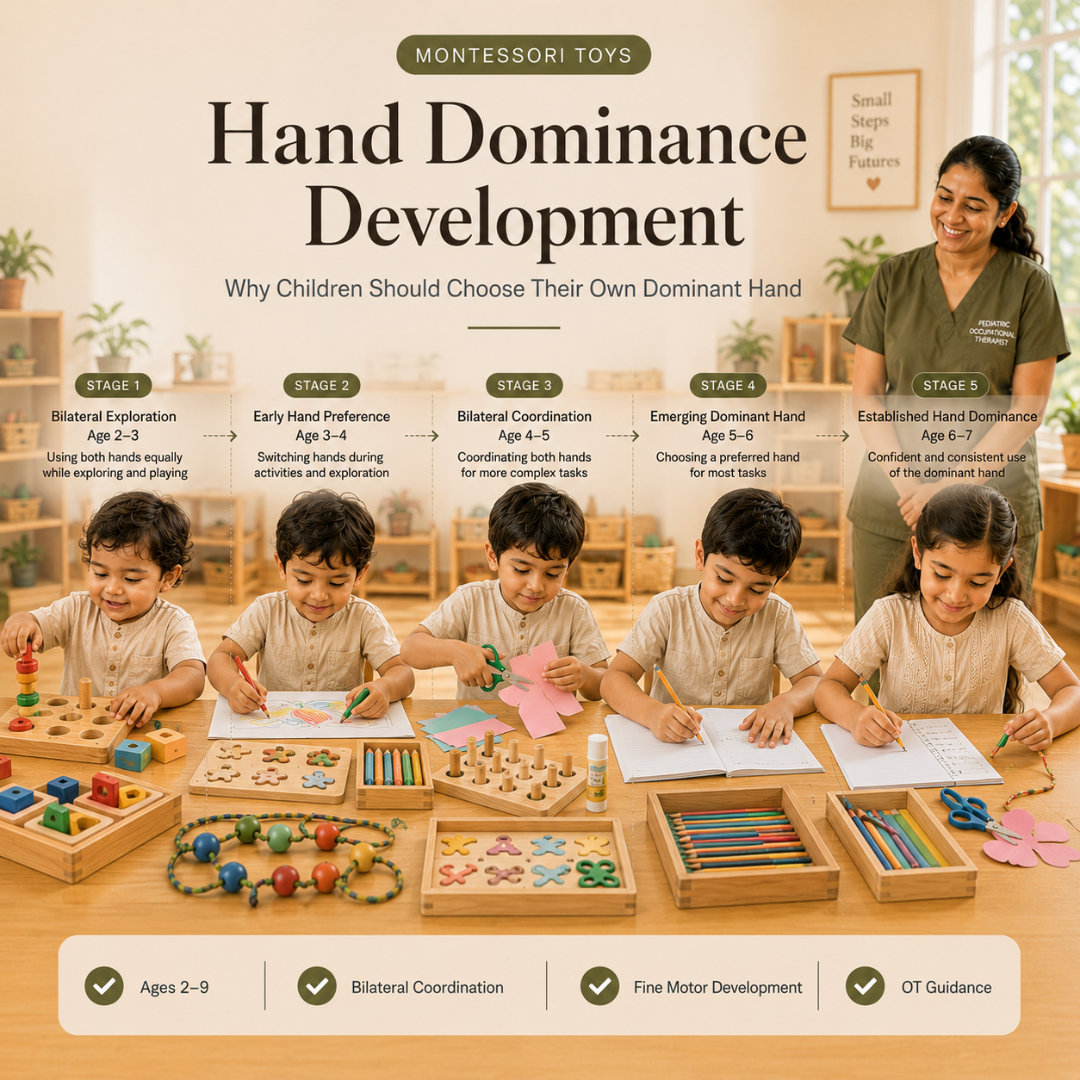
Mixed Dominance vs True Ambidexterity
Parents often describe a hand-switching child as "ambidextrous," but this label is usually inaccurate, and the distinction matters for how you respond. Mixed hand dominance describes a child who switches hands during tasks because neither hand is genuinely strong or coordinated, both hands lack precision, and the child has not yet settled into a dominant side
True ambidexterity is different and considerably rarer, describing a person who can genuinely perform tasks like writing or cutting with equally high accuracy and control using either hand. Occupational therapy sources are clear that most children who switch hands are showing mixed dominance, not true ambidexterity, since their accuracy tends to be inconsistent or poor with both hands rather than strong with both
| Pattern | What It Looks Like |
|---|---|
| Mixed dominance | Switches hands often, neither hand shows strong coordination or precision |
| True ambidexterity | Both hands perform tasks like writing and cutting with genuinely good accuracy |
If a child is still showing mixed dominance well into kindergarten, occupational therapy guidance suggests this is worth looking into and addressing, rather than assuming it will resolve entirely on its own
How to Observe Hand Preference Without Influencing It
Rather than asking a child directly which hand they prefer, occupational therapists recommend a simple, low-pressure observation method:
- Place an object, like a crayon or pair of scissors, directly at the midline of the child's body, not off to one side
- Watch which hand reaches for the object first, without prompting or suggesting either hand
- If the child switches hands mid-task, encourage them to finish the activity with the same hand, offering a short rest break if needed rather than letting fatigue drive the switch
- Repeat this observation across many different activities and days rather than drawing conclusions from a single instance
Over several weeks of this kind of relaxed observation, a pattern usually starts to emerge on its own, one hand gets chosen more frequently and shows more control, and that is the point where you can begin gently reinforcing dominant and assisting hand roles
Activities That Support Dominance Development
A range of everyday activities, drawn directly from occupational therapy guidance, support the natural emergence of hand dominance at different stages:
- Two-handed bilateral play first: Messy play with paint, playing with a rolling pin and cutters, or catching and rolling a large ball, which builds the foundation dominance emerges from
- Threading and lacing: Buttons, beads, or macaroni on a string, which naturally requires one hand to lead while the other assists
- Screwing and unscrewing lids: One hand grips the lid while the other stabilizes the jar, a clear dominant-and-assisting pattern
- Scooping and stirring: Using a spoon to scoop beans or stir a bowl while the other hand stabilizes the container
- Cutting with scissors: One hand cuts while the other stabilizes and turns the paper, directly reinforcing the dominant and assisting hand relationship
Support natural hand dominance development through play. Our Educational Peg Boards work beautifully as a midline activity, letting your child choose which hand leads without any influence from placement or side.
Shop Educational Peg Boards Find Us on Google Business ProfileWhy the Assisting Hand Matters Just as Much
It is easy to focus entirely on which hand becomes dominant, but occupational therapy guidance is equally focused on the assisting or stabilizing hand's role, since true hand dominance is really about two hands working together in complementary roles, not one hand working alone Once a preference starts to emerge, the recommended next step is deliberately developing both the dominant hand's active role and the assisting hand's stabilizing role together
This mirrors exactly what we covered in our scissor skills guide, where the "helping hand" that stabilizes and turns the paper is just as essential to good cutting as the hand actually holding the scissors. The same principle applies across nearly every two-handed fine motor task a child will encounter.
When to Seek Professional Support
Switching hands frequently before age 4 is expected and does not need any intervention. It is worth consulting an occupational therapist if a child is still showing clearly mixed dominance, poor coordination and precision with both hands, by kindergarten age, or if a lack of established hand preference is accompanied by broader fine motor delays or noticeable difficulty with handwriting and cutting tasks
An occupational therapy evaluation can determine whether a child is showing typical late-developing dominance, genuine ambidexterity, or an unestablished hand preference that would benefit from targeted bilateral coordination activities
Frequently Asked Questions
At what age should a child have a dominant hand?
Most children develop a clear, established hand preference between age 4 and 6, though early signs can appear as early as age 2, and full dominance can continue developing as late as age 8 or 9 in some children.
Should I choose a hand for my child if they keep switching?
No, occupational therapists strongly advise against choosing a hand for a child, as this can interfere with their natural hand preference development. Let the child choose freely, especially before age 4.
Is my child ambidextrous if they switch hands often?
Probably not. Most hand-switching children show mixed dominance, meaning neither hand is particularly strong or precise, rather than true ambidexterity, where both hands perform equally well.
How can I observe my child's hand preference without influencing it?
Place objects directly at the center of your child's body rather than to one side, and simply watch which hand they reach for first across many activities and days, without prompting either hand.
What activities help hand dominance develop?
Two-handed bilateral play like messy paint or ball games first, followed by threading, lacing, scooping, and cutting activities that naturally require one hand to lead while the other stabilizes.
When should I be concerned about hand dominance delays?
It is worth consulting an occupational therapist if a child still shows clearly mixed dominance by kindergarten age, or if it is paired with broader fine motor delays or handwriting and cutting difficulties.
Related reading:
- Scissor Skills by Age: Complete Development Timeline and Readiness Guide
- Tactile Sensitivity and Fine Motor Skills: Helping Kids Who Avoid or Crave Touch
- Sensory-Friendly Fine Motor Routine: Daily Activities That Help Kids Focus
- Vestibular Input and Fine Motor Skills: Helping Active Kids Focus Through Movement
- Sensory Seekers and Fine Motor Skills: Helping Kids Focus Through Movement
- Fine Motor Milestones Birth to Age 5: Complete Development Chart
Ready to give your child the freedom to choose their own dominant hand through play? Browse our peg board collection, ideal for midline placement that lets natural hand preference emerge.
Shop Educational Peg Boards Visit Our Google Business ProfileMontessori Toys Team
We research child development guidelines to help parents choose toys that genuinely support learning at every stage.