

By Montessori Toys · Updated July 2026 · 16 min read
Proprioception and Pencil Pressure: Why Some Kids Write Too Hard or Too Light
In this guide:
- What proprioception actually means
- What graded force means for handwriting
- Two patterns: writing too hard vs too light
- How this connects to the rest of the series
- Heavy work: the foundation for graded force
- Activities for kids who press too hard
- Activities for kids who press too lightly
- When to seek professional support
- Frequently asked questions
So far in this series, we have focused on skills you can watch happen, hand dominance, midline crossing, bilateral coordination. Proprioception is different, it is an invisible internal sense that a child cannot see or point to, yet it quietly controls something every parent notices immediately: how hard their child presses a pencil, crayon, or pen onto paper.
What Proprioception Actually Means
Proprioception is the body's awareness system, giving the brain information about where the body is in space, how much force to use, how much pressure to apply, and how fast or slow to move. It works constantly in the background, without conscious thought, which is exactly why difficulties with it can be so easy to overlook until they show up clearly in handwriting.
For handwriting specifically, proprioception helps a child hold the pencil with the right amount of pressure, control letter size and spacing, move the pencil smoothly across the page, maintain posture while writing, and avoid fatigue. When this system is underdeveloped or processes input inefficiently, children struggle to regulate the pressure they apply while writing.
What Graded Force Means for Handwriting
Graded force is the ability to adjust how much pressure to place on an object or person based on feedback from the environment, and it relies directly on having a good sense of body awareness and a solid proprioceptive system . Grading pressure when writing, coloring, or drawing relies heavily on the body's ability to use information from the proprioceptive system, and this ability varies considerably from child to child.
A child with well-developed graded force can seamlessly shift from pressing firmly to trace a raised line, to writing lightly on thin paper, to coloring a gradient from light to dark, all without consciously thinking about the adjustment. A child without this skill tends to apply one fixed amount of pressure regardless of the task, which is where the two common patterns below come from.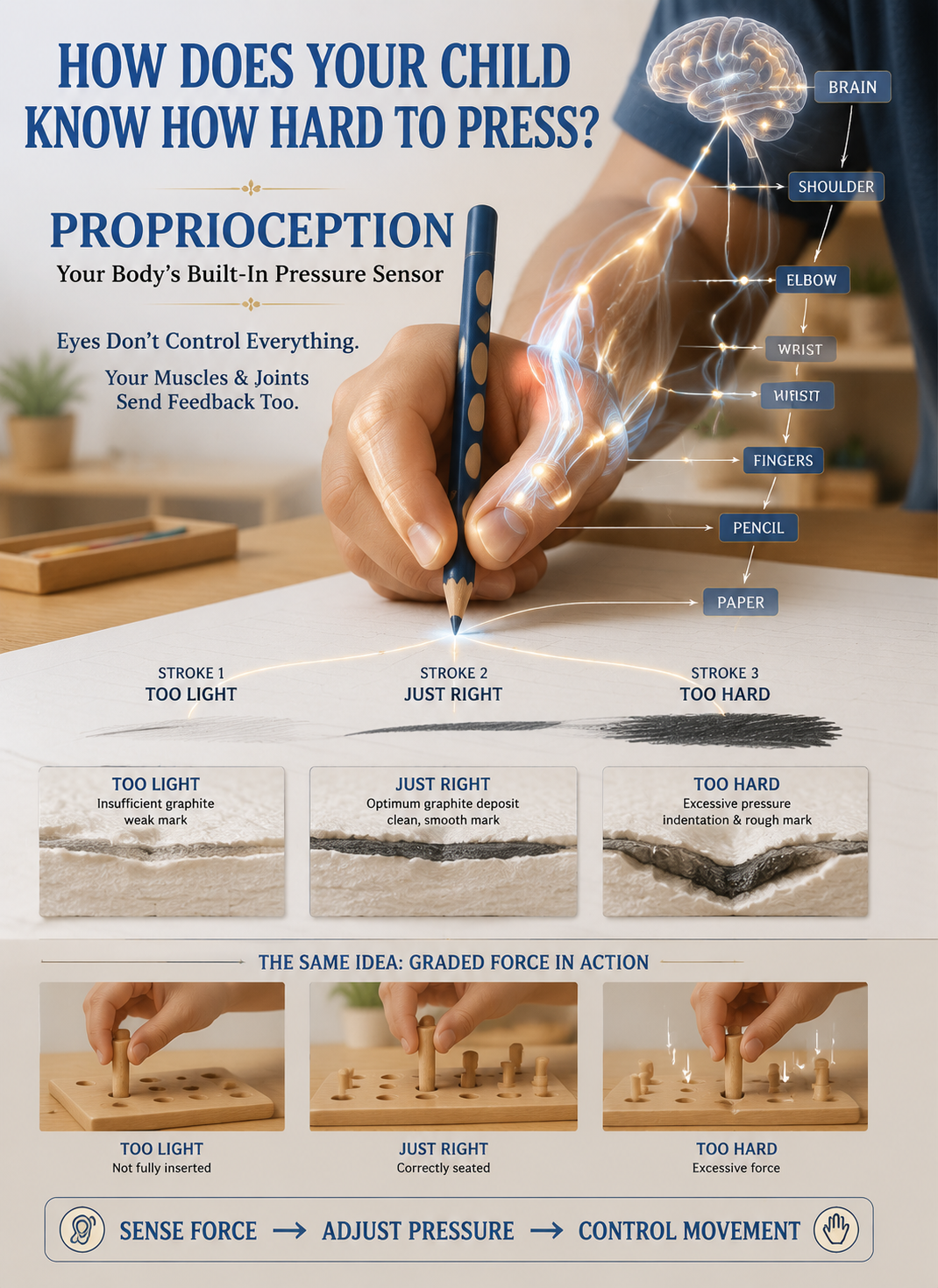
Two Patterns: Writing Too Hard vs Too Light
| Pattern | What It Looks Like |
|---|---|
| Pressing too hard | Frequently breaks pencil leads, tears or indents paper, tires quickly while writing, grips the pencil very tightly |
| Pressing too lightly | Writing appears faint or inconsistent, may seem to lack awareness of how the pencil is contacting the page |
Both patterns stem from the same underlying cause, difficulty using proprioceptive feedback to regulate force, but the fixes point in opposite directions, calming and building awareness for hard pressers, and adding resistance and feedback for light pressers.
How This Connects to the Rest of the Series
Proprioception does not work in isolation from the other skills covered in this series. Grading force whilst painting or writing requires the same asymmetrical bilateral coordination discussed earlier, one hand stabilizing the paper while the other applies carefully modulated pressure with the pencil A child who has not yet developed strong bilateral coordination or in-hand manipulation will often struggle even more visibly with force regulation, since the underlying stability those skills provide is what allows proprioceptive feedback to be used effectively in the first place.
Heavy Work: The Foundation for Graded Force
The best way to support pencil pressure overall is providing more proprioceptive input, often called "heavy work," which gives muscles and joints the feedback they need to improve regulation and control . Heavy work activities include pushing, pulling, climbing, carrying, and jumping, all of which give the body strong, clear proprioceptive input before fine motor tasks like writing.
Building proprioception directly into writing practice can include writing on a vertical surface like an easel or chalkboard, coloring with broken crayon stubs, writing on textured paper, or tracing over raised lines, all of which increase the sensory feedback available during the task itself
Activities for Kids Who Press Too Hard
- Using a mechanical pencil, since breaking the lead when pressing too hard gives an immediate, natural consequence and feedback
- Coloring different shades using the same crayon or pencil, moving gradually from light pink to medium pink to red, to build awareness of how much pressure creates each effect
- Drawing on a balloon with a felt tip or ballpoint pen without popping it, which requires immediate, careful modulation of force
- Salt painting crafts and other activities where pushing too hard visibly ruins the effect, giving natural feedback
Activities for Kids Who Press Too Lightly
- Carpet samples, since drawing shapes on a carpet tile adds resistance and naturally encourages pressing harder
- Playdough, rolling it out and drawing shapes into it, or placing dough over paper to see if marks transfer through
- Carbon copy paper between multiple layers, encouraging the child to write hard enough to transfer through to lower sheets
- A pencil with heavier lead, which makes it easier to produce a visible mark with less effort while building the habit
- Squiggly, vibrating, or sensory-feedback pens that respond differently depending on the pressure applied
Build proprioceptive awareness through hands-on play. Our Educational Peg Boards require a child to feel and adjust the amount of push needed to seat each peg firmly, giving natural, repeated feedback on force and pressure.
Shop Educational Peg Boards Find Us on Google Business ProfileWhen to Seek Professional Support
Some inconsistency in pencil pressure is expected while children are still building writing endurance and control. It is worth consulting an occupational therapist if a child consistently breaks pencil leads or tears paper, tires unusually quickly during writing tasks, or produces writing so faint it is difficult to read, especially if these patterns persist despite regular practice
An occupational therapist can properly assess proprioceptive processing and design a targeted sensory diet, since to truly improve graded force, the proprioceptive system needs to be worked on through sensory integration under professional guidance
Frequently Asked Questions
What is proprioception?
Proprioception is the body's internal awareness system, giving the brain information about body position, movement speed, and how much force or pressure to apply during a task.
Why does my child press so hard when writing?
Pressing too hard often reflects difficulty using proprioceptive feedback to regulate force, meaning the child's body is not accurately sensing how much pressure is actually needed for the task.
Why does my child's writing look so faint?
Light, faint writing often reflects the opposite proprioceptive pattern, where the child is not registering enough sensory feedback to know they need to press harder for legible marks.
What is heavy work and how does it help?
Heavy work refers to activities like pushing, pulling, climbing, and carrying that provide strong proprioceptive input, helping the muscles and joints improve force regulation before fine motor tasks.
What activities help with pencil pressure?
Mechanical pencils and balloon drawing help hard pressers, while carpet samples, playdough, and carbon paper help light pressers build more awareness and force.
When should I be concerned about pencil pressure issues?
Consult an occupational therapist if a child consistently breaks pencils, tears paper, tires quickly while writing, or produces illegibly faint writing despite regular practice.
Related reading:
- Bilateral Coordination in Children: Development, Activities, and Milestones
- Hand-Eye Coordination in Children: Visual-Motor Development by Age
- Hand Dominance in Children: When It Develops and Why You Shouldn't Choose
- Crossing the Midline in Children: Why It Matters for Writing and Coordination
- Tactile Sensitivity and Fine Motor Skills: Helping Kids Who Avoid or Crave Touch
- Sensory-Friendly Fine Motor Routine: Daily Activities That Help Kids Focus
- Vestibular Input and Fine Motor Skills: Helping Active Kids Focus Through Movement
- Sensory Seekers and Fine Motor Skills: Helping Kids Focus Through Movement
- Fine Motor Milestones Birth to Age 5: Complete Development Chart
Ready to build proprioceptive awareness through play? Browse our peg board collection, ideal for practicing controlled, graded force.
Shop Educational Peg Boards Visit Our Google Business ProfileMontessori Toys Team
We research child development guidelines to help parents choose toys that genuinely support learning at every stage.