

By Montessori Toys · Updated July 2026 · 17 min read
Praxis and Motor Planning in Children: How Kids Learn to “Think, Plan, and Do”
In this guide:
- What praxis and motor planning actually mean
- The three components: ideation, planning, execution
- Everyday examples parents can spot
- How praxis ties this whole fine-motor series together
- Signs a child struggles with motor planning
- Activities that build praxis step by step
- When to seek professional support
- Frequently asked questions
Across this series, we have explored individual skills, proprioception, bilateral coordination, hand-eye coordination, crossing the midline, and hand dominance. Praxis is different, it is not a single movement but the whole process the brain uses to turn a goal like “tie my shoes” or “climb that ladder” into a coordinated sequence of actions. Understanding praxis helps make sense of why some children can perform a skill once when shown, but struggle to remember or repeat it smoothly later.
What Praxis and Motor Planning Actually Mean
Praxis is the ability to conceptualize, plan, and organize a task in order to execute a motor skill from beginning to end ]. It is sometimes referred to as “motor planning,” but strictly speaking, motor planning is one part of praxis, not the whole picture
Praxis relies heavily on sensory integration, particularly the integration of tactile, proprioceptive, and vestibular input, to understand and organize the body in space and execute purposeful actions When these sensory systems are working together well, the brain can build and refine motor plans efficiently, gradually making complex skills more automatic.
The Three Components: Ideation, Planning, Execution
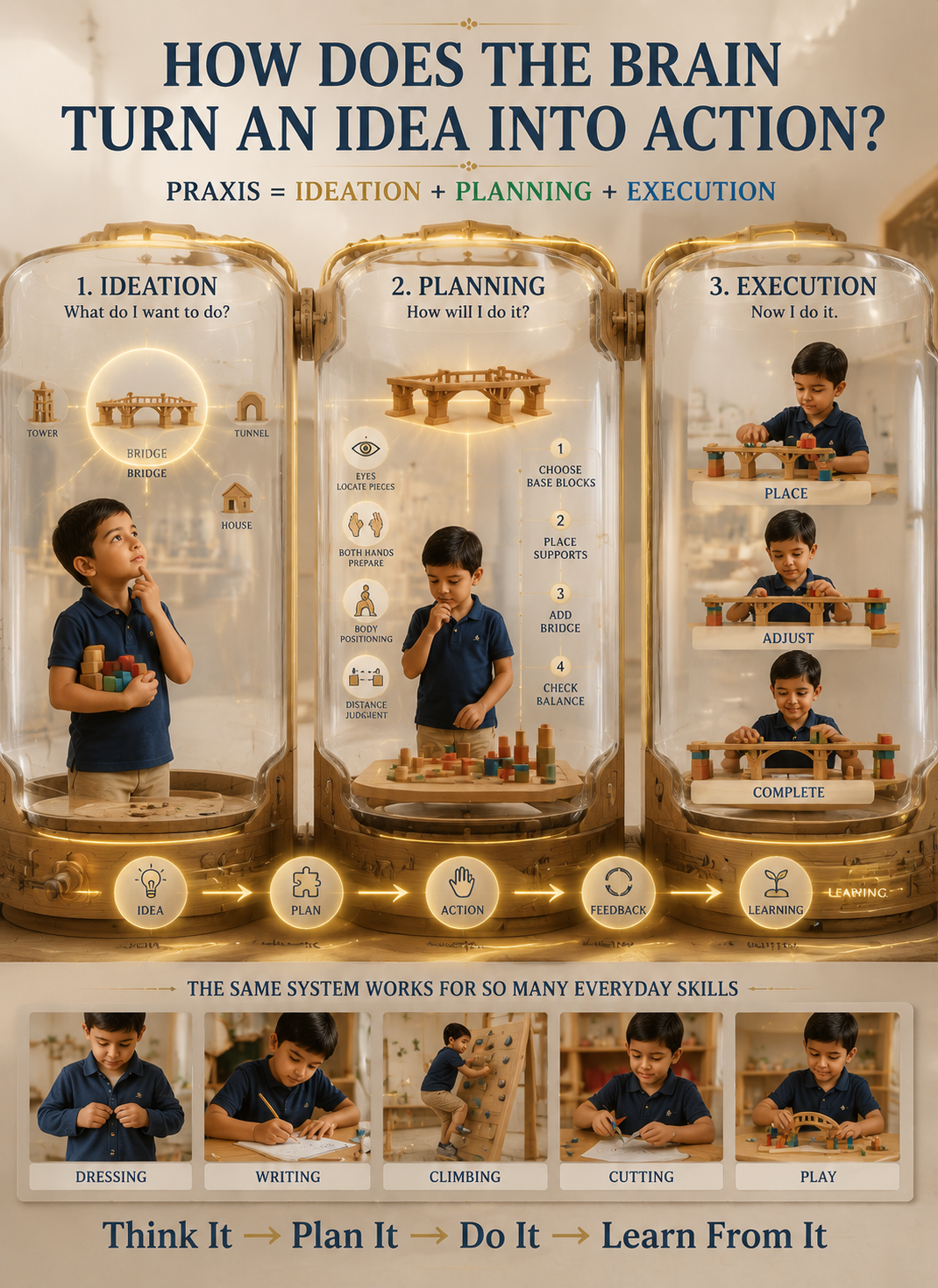
Occupational therapy guidance generally breaks praxis into three main components that happen in sequence
- Ideation: Generating an idea of what you want to do, such as “build a bridge,” “jump over that gap,” or “write my name”
- Motor planning (organisation): Figuring out how you are going to do it, choosing the sequence of movements and which body parts will be involved
- Execution: Carrying out the movements in the correct order, adjusting as needed based on feedback from the body and environment
Children practice this three-step loop constantly as they engage in play. Climbing a new piece of playground equipment or learning to ride a bike are classic praxis tasks, because they require ideation, planning, and execution for a novel motor action rather than a memorized routine
Everyday Examples Parents Can Spot
Motor planning is easiest to see in multi-step tasks that involve both the body and the hands. Common examples include
- Tying shoelaces, which requires forming an idea, sequencing loops and pulls, and coordinating both hands without stopping to re-think each step
- Writing a short note, which requires planning letter formation, spacing, and posture while keeping the overall message in mind
- Climbing a playground ladder and then deciding how to get back down, such as stepping, sliding, or jumping off safely
- Following a simple obstacle course with instructions like “crawl under, step over, then jump,” keeping all three steps in mind while moving
How Praxis Ties This Whole Fine-Motor Series Together
Praxis sits on top of the individual skills covered elsewhere in this series. It depends on proprioception for understanding body position and grading force, vestibular input for balance and movement, tactile input for feedback from tools and materials, and bilateral coordination to use both sides of the body together effectively Without these foundations, motor plans are harder to create and refine.
This is also why children with praxis difficulties often struggle with handwriting, dressing, and playground play. Each of those tasks requires a combination of hand dominance, midline crossing, hand-eye coordination, and bilateral coordination, all guided by a motor plan that sequences movements and adjusts them in real time
Signs a Child Struggles With Motor Planning
Children with praxis difficulties (often described as dyspraxia or Developmental Coordination Disorder when more severe) tend to show recognizable patterns
- Appearing clumsy or awkward with movements, bumping into objects or misjudging distances during play
- Avoiding new movement games or playground equipment, preferring familiar, repetitive actions
- Struggling to follow multi-step motor instructions like “jump, then spin, then clap” even when they understand the words
- Difficulty learning sequences like tying shoelaces, using cutlery smoothly, or following an obstacle course without stopping frequently Needing significantly more repetition than peers for motor tasks to become automatic, and forgetting how to start a task they have done before
Activities That Build Praxis Step by Step
Occupational therapy guidance highlights activities that practice ideation, planning, and execution in low-pressure, playful ways
| Component | Activity |
|---|---|
| Ideation | “What else can we do with this?” games, encouraging the child to come up with new uses for familiar objects, like building a tunnel with cushions or a bridge with blocks |
| Planning | Simple obstacle courses where the child helps plan the route, then repeats it, gradually increasing the number of steps |
| Execution | Action sequences like “jump, clap, spin,” dancing to follow-the-leader routines, and multi-step animal walks (crawl, hop, slither) |
| Combined praxis | Building and copying block or peg board patterns, where the child first creates a design, then plans and executes copying it again |
Practice “think, plan, do” through hands-on pattern play. Our Educational Peg Boards are ideal for ideation (inventing designs), planning (choosing colors and positions), and execution (placing pegs in sequence).
Shop Educational Peg Boards Find Us on Google Business ProfileWhen to Seek Professional Support
Some difficulty with new motor tasks is expected, since children learn best through repetition and play. It is worth consulting an occupational therapist if a child appears significantly more clumsy than peers, consistently avoids new movement tasks, or struggles visibly with multi-step motor sequences at home or school despite clear understanding of instructions
An occupational therapist can assess which parts of praxis, ideation, planning, or execution, are most challenging, and whether underlying sensory integration differences in tactile, proprioceptive, or vestibular systems are contributing, then design a targeted plan rather than generic practice.
Frequently Asked Questions
What is praxis?
Praxis is the ability to conceptualize, plan, and execute a motor task from start to finish, especially when the action is new or unfamiliar, and it relies on good sensory integration.
What is motor planning?
Motor planning is the planning and sequencing part of praxis, figuring out how the body will move to achieve the goal, which movements come first, and how they fit together.
How does praxis relate to handwriting and dressing?
Handwriting and dressing both require multi-step motor plans, combining hand dominance, bilateral coordination, and sensory feedback into smooth, sequenced actions.
What are signs of motor planning difficulties?
Clumsiness, avoiding new movement tasks, struggling with multi-step motor instructions, and needing much more repetition than peers for skills to become automatic.
What activities build praxis?
Obstacle courses, action sequences, follow-the-leader games, and building or copying designs with blocks or peg boards all practice ideation, planning, and execution together.
When should I seek help for possible dyspraxia?
Seek occupational therapy advice if a child’s coordination and motor planning difficulties impact daily functioning at home or school, or if teachers raise ongoing concerns.
Related reading:
- Proprioception and Pencil Pressure: Why Kids Write Too Hard or Too Light
- Bilateral Coordination in Children: Development, Activities, and Milestones
- Hand-Eye Coordination in Children: Visual-Motor Development by Age
- Hand Dominance in Children: When It Develops and Why You Shouldn't Choose
- Crossing the Midline in Children: Why It Matters for Writing and Coordination
- Tactile Sensitivity and Fine Motor Skills: Helping Kids Who Avoid or Crave Touch
- Sensory-Friendly Fine Motor Routine: Daily Activities That Help Kids Focus
- Vestibular Input and Fine Motor Skills: Helping Active Kids Focus Through Movement
- Sensory Seekers and Fine Motor Skills: Helping Kids Focus Through Movement
- Fine Motor Milestones Birth to Age 5: Complete Development Chart
Ready to turn “think, plan, do” into everyday play? Browse our peg board collection, ideal for building and copying designs that practice praxis in a playful, child-led way.
Shop Educational Peg Boards Visit Our Google Business ProfileMontessori Toys Team
We research child development guidelines to help parents choose toys that genuinely support learning at every stage.
By Montessori Toys · Updated July 2026 · 17 min read
Praxis and Motor Planning in Children: How Kids Learn to “Think, Plan, and Do”
In this guide:
- What praxis and motor planning actually mean
- The three components: ideation, planning, execution
- Everyday examples parents can spot
- How praxis ties this whole fine-motor series together
- Signs a child struggles with motor planning
- Activities that build praxis step by step
- When to seek professional support
- Frequently asked questions
Across this series, we have explored individual skills, proprioception, bilateral coordination, hand-eye coordination, crossing the midline, and hand dominance. Praxis is different, it is not a single movement but the whole process the brain uses to turn a goal like “tie my shoes” or “climb that ladder” into a coordinated sequence of actions. Understanding praxis helps make sense of why some children can perform a skill once when shown, but struggle to remember or repeat it smoothly later.
What Praxis and Motor Planning Actually Mean
Praxis is the ability to conceptualize, plan, and organize a task in order to execute a motor skill from beginning to end It is sometimes referred to as “motor planning,” but strictly speaking, motor planning is one part of praxis, not the whole picture
Praxis relies heavily on sensory integration, particularly the integration of tactile, proprioceptive, and vestibular input, to understand and organize the body in space and execute purposeful actions. When these sensory systems are working together well, the brain can build and refine motor plans efficiently, gradually making complex skills more automatic.
The Three Components: Ideation, Planning, Execution
Occupational therapy guidance generally breaks praxis into three main components that happen in sequence :
- Ideation: Generating an idea of what you want to do, such as “build a bridge,” “jump over that gap,” or “write my name”
- Motor planning (organisation): Figuring out how you are going to do it, choosing the sequence of movements and which body parts will be involved]
- Execution: Carrying out the movements in the correct order, adjusting as needed based on feedback from the body and environment
Children practice this three-step loop constantly as they engage in play. Climbing a new piece of playground equipment or learning to ride a bike are classic praxis tasks, because they require ideation, planning, and execution for a novel motor action rather than a memorized routine
Everyday Examples Parents Can Spot
Motor planning is easiest to see in multi-step tasks that involve both the body and the hands. Common examples include:
- Tying shoelaces, which requires forming an idea, sequencing loops and pulls, and coordinating both hands without stopping to re-think each step
- Writing a short note, which requires planning letter formation, spacing, and posture while keeping the overall message in mind
- Climbing a playground ladder and then deciding how to get back down, such as stepping, sliding, or jumping off safely
- Following a simple obstacle course with instructions like “crawl under, step over, then jump,” keeping all three steps in mind while moving
How Praxis Ties This Whole Fine-Motor Series Together
Praxis sits on top of the individual skills covered elsewhere in this series. It depends on proprioception for understanding body position and grading force, vestibular input for balance and movement, tactile input for feedback from tools and materials, and bilateral coordination to use both sides of the body together effectively Without these foundations, motor plans are harder to create and refine.
This is also why children with praxis difficulties often struggle with handwriting, dressing, and playground play. Each of those tasks requires a combination of hand dominance, midline crossing, hand-eye coordination, and bilateral coordination, all guided by a motor plan that sequences movements and adjusts them in real time
Signs a Child Struggles With Motor Planning
Children with praxis difficulties (often described as dyspraxia or Developmental Coordination Disorder when more severe) tend to show recognizable patterns:
- Appearing clumsy or awkward with movements, bumping into objects or misjudging distances during play
- Avoiding new movement games or playground equipment, preferring familiar, repetitive actions
- Struggling to follow multi-step motor instructions like “jump, then spin, then clap” even when they understand the words [
- Difficulty learning sequences like tying shoelaces, using cutlery smoothly, or following an obstacle course without stopping frequently]
- Needing significantly more repetition than peers for motor tasks to become automatic, and forgetting how to start a task they have done before
Activities That Build Praxis Step by Step
Occupational therapy guidance highlights activities that practice ideation, planning, and execution in low-pressure, playful ways
| Component | Activity |
|---|---|
| Ideation | “What else can we do with this?” games, encouraging the child to come up with new uses for familiar objects, like building a tunnel with cushions or a bridge with blocks |
| Planning | Simple obstacle courses where the child helps plan the route, then repeats it, gradually increasing the number of steps |
| Execution | Action sequences like “jump, clap, spin,” dancing to follow-the-leader routines, and multi-step animal walks (crawl, hop, slither) 5] |
| Combined praxis | Building and copying block or peg board patterns, where the child first creates a design, then plans and executes copying it again ] |
Practice “think, plan, do” through hands-on pattern play. Our Educational Peg Boards are ideal for ideation (inventing designs), planning (choosing colors and positions), and execution (placing pegs in sequence).
Shop Educational Peg Boards Find Us on Google Business ProfileWhen to Seek Professional Support
Some difficulty with new motor tasks is expected, since children learn best through repetition and play. It is worth consulting an occupational therapist if a child appears significantly more clumsy than peers, consistently avoids new movement tasks, or struggles visibly with multi-step motor sequences at home or school despite clear understanding of instructions
An occupational therapist can assess which parts of praxis, ideation, planning, or execution, are most challenging, and whether underlying sensory integration differences in tactile, proprioceptive, or vestibular systems are contributing, then design a targeted plan rather than generic practice.
Frequently Asked Questions
What is praxis?
Praxis is the ability to conceptualize, plan, and execute a motor task from start to finish, especially when the action is new or unfamiliar, and it relies on good sensory integration.
What is motor planning?
Motor planning is the planning and sequencing part of praxis, figuring out how the body will move to achieve the goal, which movements come first, and how they fit together.
How does praxis relate to handwriting and dressing?
Handwriting and dressing both require multi-step motor plans, combining hand dominance, bilateral coordination, and sensory feedback into smooth, sequenced actions.
What are signs of motor planning difficulties?
Clumsiness, avoiding new movement tasks, struggling with multi-step motor instructions, and needing much more repetition than peers for skills to become automatic.
What activities build praxis?
Obstacle courses, action sequences, follow-the-leader games, and building or copying designs with blocks or peg boards all practice ideation, planning, and execution together.
When should I seek help for possible dyspraxia?
Seek occupational therapy advice if a child’s coordination and motor planning difficulties impact daily functioning at home or school, or if teachers raise ongoing concerns.
Related reading:
- Proprioception and Pencil Pressure: Why Kids Write Too Hard or Too Light
- Bilateral Coordination in Children: Development, Activities, and Milestones
- Hand-Eye Coordination in Children: Visual-Motor Development by Age
- Hand Dominance in Children: When It Develops and Why You Shouldn't Choose
- Crossing the Midline in Children: Why It Matters for Writing and Coordination
- Tactile Sensitivity and Fine Motor Skills: Helping Kids Who Avoid or Crave Touch
- Sensory-Friendly Fine Motor Routine: Daily Activities That Help Kids Focus
- Vestibular Input and Fine Motor Skills: Helping Active Kids Focus Through Movement
- Sensory Seekers and Fine Motor Skills: Helping Kids Focus Through Movement
- Fine Motor Milestones Birth to Age 5: Complete Development Chart
Ready to turn “think, plan, do” into everyday play? Browse our peg board collection, ideal for building and copying designs that practice praxis in a playful, child-led way.
Shop Educational Peg Boards Visit Our Google Business ProfileMontessori Toys Team
We research child development guidelines to help parents choose toys that genuinely support learning at every stage.