

By Montessori Toys · Updated July 2026 · 17 min read
Executive Function and Handwriting: How Attention, Working Memory, and Self-Regulation Impact Fine Motor Skills
In this guide:
- What executive function actually means
- The three core skills: attention, working memory, inhibition
- Why these skills matter so much for handwriting
- Research snapshot: fine motor, EF, and school readiness
- Signs executive function may be affecting writing
- Activities that build EF through play
- When to seek professional support
- Frequently asked questions
By this point in the series, we have moved from individual motor skills like hand dominance and crossing the midline to broader systems like proprioception and praxis. Executive function is the final layer that helps children actually use those skills in real-life situations, regulate their behavior, and manage classroom demands. It is the difference between being able to form letters in a quiet, one-on-one setting and being able to write a sentence in a busy classroom with time limits and distractions.
What Executive Function Actually Means
Executive function (EF) is a set of cognitive skills that support self-regulation, allowing children to manage their emotions, sustain attention, follow rules, and adapt flexibly to classroom demands [web:451][web:442]. It includes abilities like holding information in mind, controlling impulses, and shifting strategies when needed, all of which are important for school readiness and everyday learning [web:451][web:446].
Research on preschool and early school years consistently shows that EF and motor skills are important for early learning, and that they codevelop in bidirectional, synergistic ways, meaning each influences the development of the other over time [web:443][web:454]. Children with stronger fine motor skills often show stronger executive function, and vice versa [web:450][web:444].
The Three Core Skills: Attention, Working Memory, Inhibition
While executive function includes several components, three are especially important for handwriting and fine-motor tasks [web:451][web:448]:
- Attention: The ability to focus on relevant information and sustain that focus long enough to complete a task, such as copying from the board or finishing a line of writing [web:451][web:448]
- Working memory: Holding small amounts of information in mind, such as spelling patterns or multi-step instructions, while simultaneously performing a motor task like writing [web:452][web:444]
- Inhibition (impulse control): Resisting the urge to rush, scribble, or skip steps, and instead slowing down enough to form letters carefully and follow classroom rules [web:451][web:456]
Together, these skills help a child plan what they are going to write, keep the necessary information in mind, and stay organized and consistent from the first letter to the last.
Why These Skills Matter So Much for Handwriting
Handwriting is more than just moving a pencil. Children need to remember what they are writing, maintain posture, regulate pencil pressure, and manage spacing and alignment, all while filtering out classroom distractions. Studies highlight that working memory and inhibitory control are important predictors of emergent handwriting and written spelling accuracy, because they regulate both behavioral and learning processes during writing [web:452][web:448].
Other research shows that children with attention deficit and hyperactivity disorder (ADHD) often have handwriting difficulties, including issues with legibility and speed, even when basic motor skills are adequate [web:456]. This underscores that executive function, not just hand strength or coordination, is a key ingredient for successful writing in real-world classroom conditions.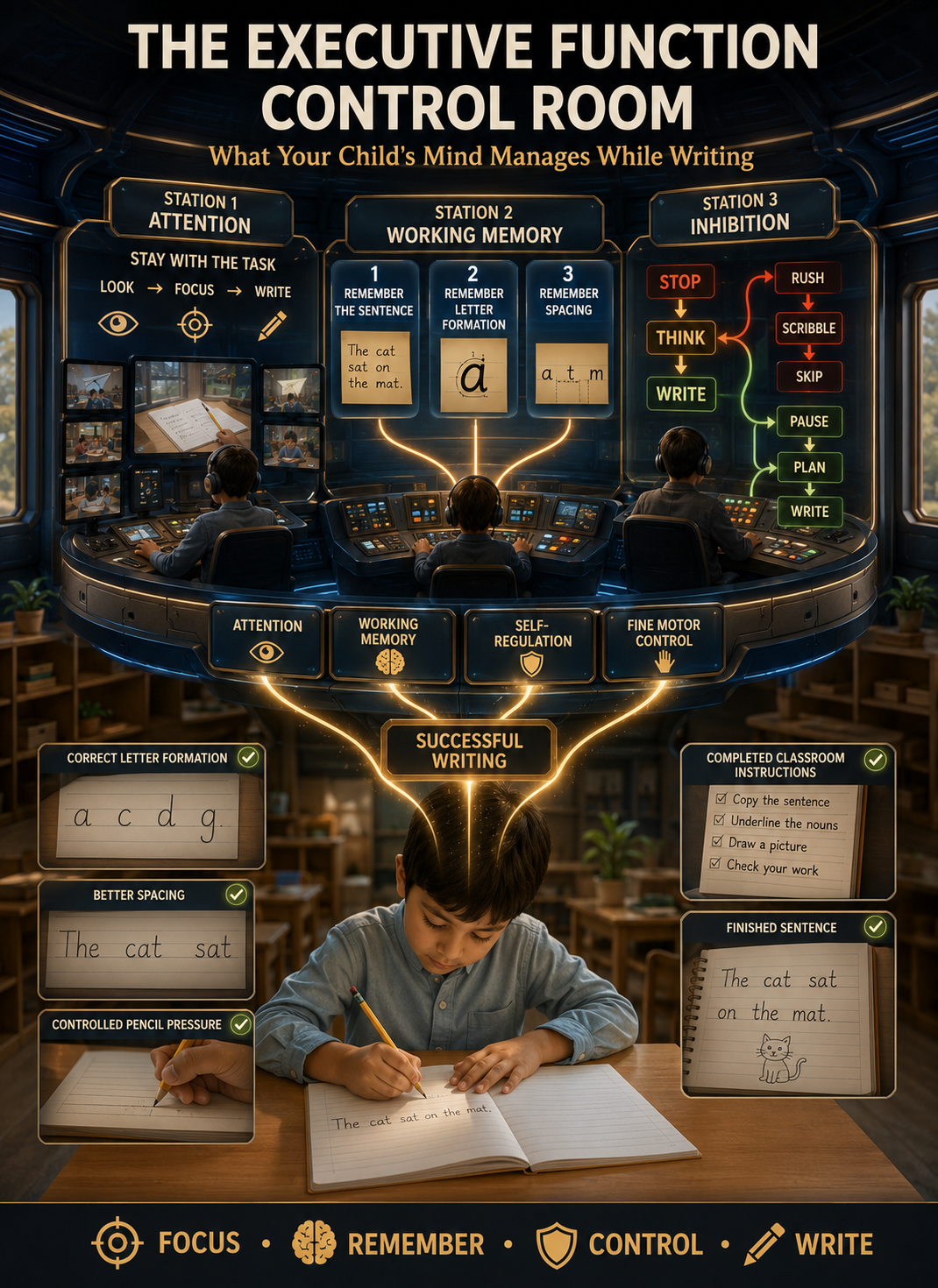
Research Snapshot: Fine Motor, EF, and School Readiness
Several recent studies have looked at how fine motor skills and executive function work together to support school readiness and academic outcomes:
| Study focus | Key finding |
|---|---|
| Fine motor & EF in preschoolers with behavior problems | Fine motor skills and executive function both uniquely predicted school readiness in preschoolers with externalizing behavior problems [web:447][web:445] |
| Fine motor & EF in kindergarten achievement | Both fine motor skills and EF contributed to kindergarten achievement, highlighting the need to support both domains for academic success [web:444][web:446] |
| Motor skills, EF, and early learning | EF and motor skills codevelop bidirectionally, and stronger gross and fine motor skills were linked with better EF skills [web:443][web:450] |
These findings support what many parents and teachers observe, children who can sit, attend, and coordinate their hands often find it easier to participate in learning activities and show what they know on paper.
Signs Executive Function May Be Affecting Writing
Because executive function is an internal process, difficulties often show up indirectly in behavior and work output. Common signs include [web:451][web:456]:
- Starting writing tasks but quickly losing focus or getting distracted, leaving work incomplete
- Knowing what they want to say but struggling to organize it on paper, forgetting parts of the sentence midway through
- Writing quickly and messily, with poor spacing and alignment, despite adequate hand strength
- Difficulty following multi-step classroom instructions, such as “write the date, then copy the sentence, then underline the verb”
- Marked differences between verbal ability and written output, where the child can explain ideas verbally but not capture them clearly in writing
Activities That Build EF Through Play
Research-informed guidance suggests that play-based activities can strengthen executive function while also engaging fine-motor and gross-motor skills [web:451][web:446]:
- Turn-taking games: Board games and card games that require waiting for a turn, following rules, and inhibiting impulsive moves [web:451]
- Copy-and-complete patterns: Using peg boards or blocks to copy a pattern and then extend it, practicing working memory and planning [web:444]
- Movement sequences: “Simon Says” and follow-the-leader actions that become progressively longer, supporting attention and motor planning [web:431][web:429]
- Timed writing challenges: Short, low-pressure writing sprints where the focus is on staying on task for a set time rather than perfection [web:456]
- Self-check routines: Simple checklists like “Name, date, spaces, full stop” that children learn to use to review their writing, supporting self-monitoring [web:451]
Link fine-motor practice with attention and working memory. Our Educational Peg Boards are ideal for copy-and-extend pattern games that challenge children to remember sequences while placing pegs precisely.
Shop Educational Peg Boards Find Us on Google Business ProfileWhen to Seek Professional Support
Every child’s attention and self-regulation grow over time, and occasional difficulty staying on task is normal. It is worth consulting an occupational therapist, psychologist, or pediatrician if a child’s attention, working memory, or impulse control noticeably interfere with their ability to complete schoolwork, follow instructions, or show their learning in writing, especially compared with peers [web:451][web:456].
A professional can help determine whether challenges stem mainly from executive function, motor skills, sensory processing, or a combination, and can design a support plan that addresses all contributing factors rather than focusing on handwriting alone [web:442][web:447].
Frequently Asked Questions
What is executive function in children?
Executive function is a set of skills including attention, working memory, and impulse control that help children regulate behavior, follow instructions, and stay organized in learning tasks.
How does executive function affect handwriting?
EF helps children remember what they are writing, stay focused, control pencil pressure, and manage spacing and alignment so their written work is legible and complete.
Can a child have good motor skills but still struggle with writing?
Yes. A child may have adequate hand strength and coordination yet struggle with writing if attention, working memory, or self-regulation difficulties affect task completion.
What activities build executive function?
Turn-taking games, pattern copy-and-extend tasks, movement sequences like Simon Says, timed writing practice, and simple self-check routines all support EF growth.
When should I seek help for attention or self-regulation concerns?
Seek professional advice if attention, working memory, or impulse control consistently interfere with schoolwork, following instructions, or written output compared with peers.
Related reading:
- Praxis and Motor Planning in Children: Development, Activities, and Milestones
- Proprioception and Pencil Pressure: Why Kids Write Too Hard or Too Light
- Bilateral Coordination in Children: Development, Activities, and Milestones
- Hand-Eye Coordination in Children: Visual-Motor Development by Age
- Hand Dominance in Children: When It Develops and Why You Shouldn't Choose
- Crossing the Midline in Children: Why It Matters for Writing and Coordination
- Tactile Sensitivity and Fine Motor Skills: Helping Kids Who Avoid or Crave Touch
- Sensory-Friendly Fine Motor Routine: Daily Activities That Help Kids Focus
- Vestibular Input and Fine Motor Skills: Helping Active Kids Focus Through Movement
- Sensory Seekers and Fine Motor Skills: Helping Kids Focus Through Movement
- Fine Motor Milestones Birth to Age 5: Complete Development Chart
Ready to connect attention, planning, and precise hand movement? Browse our peg board collection, ideal for copy-and-extend pattern games that build executive function and fine-motor control together.
Shop Educational Peg Boards Visit Our Google Business ProfileMontessori Toys Team
We research child development guidelines to help parents choose toys that genuinely support learning at every stage.