

By Montessori Toys · Updated July 2026 · 17 min read
Sensory-Friendly Classrooms and Handwriting: Practical Supports for Focus, Comfort, and Fine Motor Skills
In this guide:
By now, we have explored fine-motor skills, sensory systems, praxis, and executive function mostly in the context of home and clinic activities. The classroom adds new demands, sustained sitting, background noise, visual clutter, and multi-step written work. Sensory-friendly accommodations bridge the gap between what a child can do in an ideal setting and what they are asked to do in a real classroom.
Why Sensory Supports Matter for Handwriting
Children with sensory processing and regulation challenges often struggle to filter out irrelevant stimuli, making it harder to focus on fine-motor tasks like handwriting and cutting
Classroom accommodations can reduce sensory overload and provide appropriate sensory input so children can better sustain attention, regulate their arousal level, and access the curriculum
Guidance for school-based occupational therapists emphasizes that simple changes in seating, positioning, access to movement, and task design can significantly improve a child’s ability to participate in handwriting and other desk work without lowering academic expectations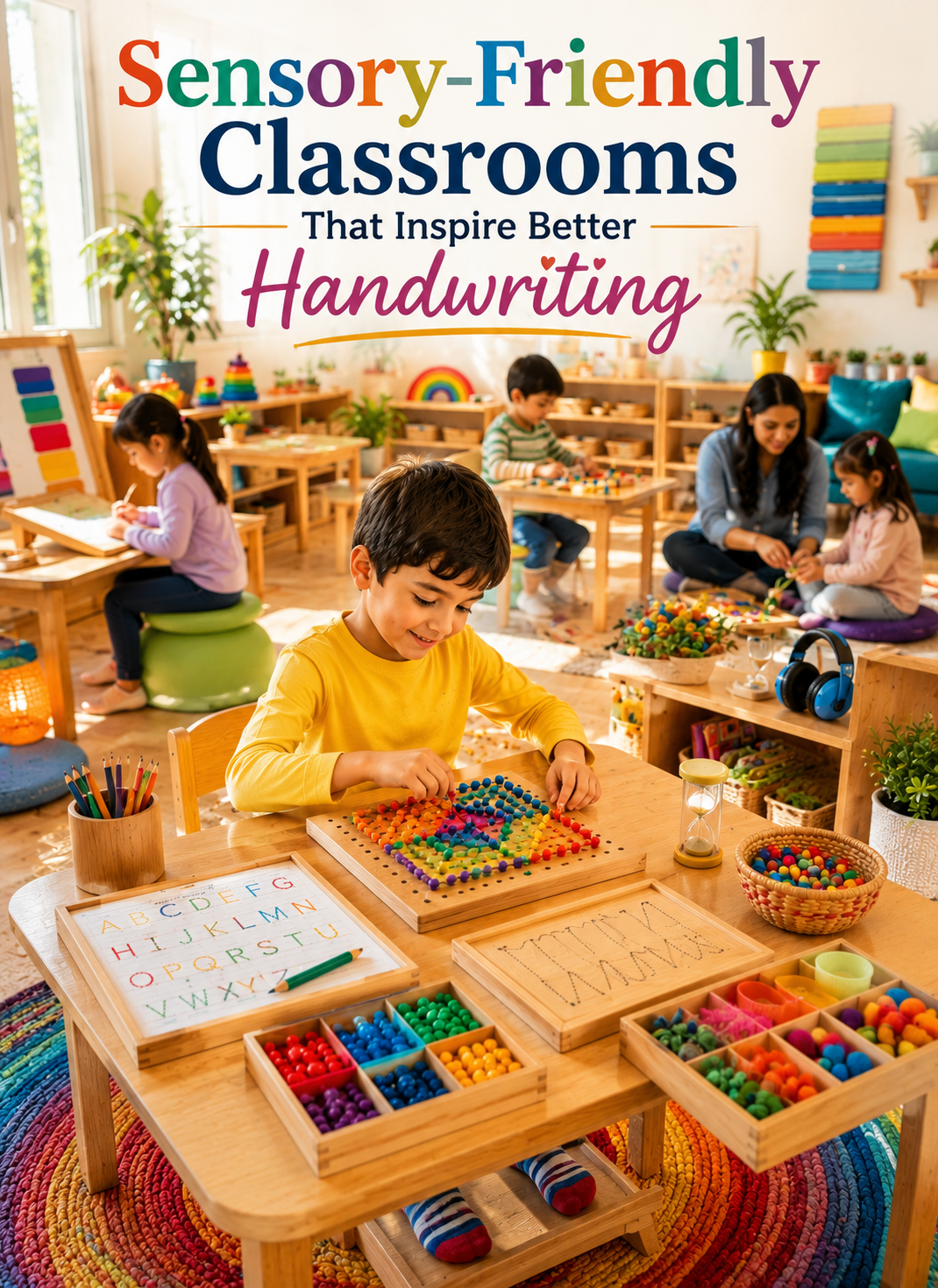
Core Areas to Consider: Seating, Noise, Visuals, Tools
Common sensory-friendly classroom supports cluster into four practical areas
- Seating and positioning: Alternative seating (wobble stools, ball chairs), footrests, and correct desk height to improve posture and body awareness
- Noise and sound: Noise-reduction strategies and quiet spaces to support children sensitive to sound or easily distracted by background noise
- Visual environment: Reduced visual clutter, clear writing spaces, and visual schedules to lower visual load and support planning
- Tools and task adaptations: Pencil grips, weighted tools, modified worksheets, and sensory breaks embedded into the day
Classroom Accommodations at a Glance
Below is a summary of widely recommended accommodations for sensory processing and regulation challenges that impact handwriting and fine-motor work
| Area | Examples |
|---|---|
| Seating and posture | Flexible seating (exercise ball chair, wobble stool, stand-up desk), seat cushions, footrests, ensuring feet flat on the floor and elbows at desk height |
| Noise and sound | Noise-reducing headphones, soft background white noise, quiet work areas for independent tasks |
| Visual environment | Decluttered walls near the child’s desk, clear designated writing space, visual schedules and timers to support transitions and planning |
| Sensory tools | Fidget tools, chewable items, stress balls, weighted lap pads, chair bands, all used with clear rules and OT guidance [ |
| Movement breaks | Scheduled sensory breaks (heavy work, stretching, short walks), movement jobs like handing out papers, built into the day ] |
| Task and worksheet adaptations | Larger writing spaces, reduced visual load on pages, highlighted writing lines, alternative formats (tracing, copying from near-point instead of far-point) |
These supports are typically considered accommodations rather than modifications, meaning they change how the child accesses and practices handwriting and fine-motor skills, not what academic content they are expected to learn.
How These Supports Connect to the Rest of the Series
Sensory-friendly classroom strategies are the practical application of many topics already covered. For example, heavy work movement breaks and chair bands directly support proprioceptive processing and graded pencil pressure, helping children regulate force before and during writing tasks . Alternative seating and posture supports help children use bilateral coordination and hand-eye coordination more efficiently by giving a stable base and clearer body awareness
Visual schedules, quiet spaces, and reduced clutter help executive function and praxis by making it easier to plan, sequence, and remember multi-step classroom routines, from “get book, write date, start copy” to “finish writing, then pack bag” In other words, sensory-friendly classrooms are where the sensory, motor, and executive skills discussed in this series come together in daily school life.
Working With Occupational Therapists at School
School-based OTs play a key role in evaluating sensory processing, fine-motor skills, and how they impact access to the curriculum. They often provide pre-referral advice and classroom observation, then recommend specific accommodations and a “sensory diet” when needed
Parents and teachers can collaborate with OTs by sharing concrete examples of when a child struggles most (e.g., writing during noisy group work vs. more focused one-on-one tasks), and by trialing recommended accommodations for a set period while monitoring changes in comfort, focus, and handwriting output
Frequently Asked Questions
What is a sensory-friendly classroom?
A sensory-friendly classroom intentionally adjusts seating, noise, visuals, and access to movement and tools so children with sensory processing and regulation differences can focus and participate more comfortably.
How do classroom accommodations help handwriting?
They reduce sensory overload, improve posture and body awareness, and provide appropriate sensory input, making it easier for children to sustain attention and use their fine-motor skills during writing.
What are simple sensory supports teachers can start with?
Flexible seating, noise-reducing headphones, brief movement breaks, decluttered workspaces, and visual schedules are commonly recommended low-cost starting points.
Do these accommodations change what a child learns?
Typically they are accommodations, changing how a child accesses and practices tasks, not the academic content or expectations, unless a formal plan specifies modifications.
When should we involve an occupational therapist?
If sensory or fine-motor challenges significantly affect a child’s comfort, focus, or ability to complete written work compared with peers, consult the school’s OT for evaluation and tailored recommendations.
Related reading:
- Executive Function and Handwriting: Attention, Memory, and Fine Motor Skills
- Praxis and Motor Planning in Children: Development, Activities, and Milestones
- Proprioception and Pencil Pressure: Why Kids Write Too Hard or Too Light
- Bilateral Coordination in Children: Development, Activities, and Milestones
- Hand-Eye Coordination in Children: Visual-Motor Development by Age
- Hand Dominance in Children: When It Develops and Why You Shouldn't Choose
- Crossing the Midline in Children: Why It Matters for Writing and Coordination
- Tactile Sensitivity and Fine Motor Skills: Helping Kids Who Avoid or Crave Touch
- Sensory-Friendly Fine Motor Routine: Daily Activities That Help Kids Focus
- Vestibular Input and Fine Motor Skills: Helping Active Kids Focus Through Movement
- Sensory Seekers and Fine Motor Skills: Helping Kids Focus Through Movement
- Fine Motor Milestones Birth to Age 5: Complete Development Chart
Ready to bring sensory-friendly fine-motor practice into your classroom? Browse our peg board collection, ideal for center-based pattern and motor planning activities that fit neatly within a sensory-supportive environment.
Shop Educational Peg Boards Visit Our Google Business ProfileMontessori Toys Team
We research child development guidelines to help parents and teachers choose toys and strategies that genuinely support learning at every stage.