

By Montessori Toys · Updated July 2026 · 17 min read
Home Routines for Fine Motor and Handwriting: Simple Daily Activities That Make Skills Stick
In this guide:
Occupational therapy resources increasingly highlight that families do not need special equipment or long practice sessions to support fine-motor and handwriting skills at home. Everyday tasks like getting dressed, helping in the kitchen, playing with household items, and short, focused writing practice periods can all be woven into family routines to support skill development [
Why Home Routines Matter for Fine Motor Skills
Fine-motor skills underpin everyday tasks like dressing, eating, playing with toys, and writing, and they improve most reliably with frequent, low-pressure practice in meaningful contexts. A short daily routine can build hand strength, dexterity, and coordination without feeling like a “lesson,” especially when activities are embedded into play and family life
Home programmes from occupational therapists emphasise that repetition over days and weeks is more important than intensity on any single day, and that using familiar, household materials makes it easier for families to stay consistentThe goal is not perfect handwriting overnight, but steady growth in the underlying skills that make writing more comfortable and automatic.
Three Principles for Effective Home Practice
Across guidelines, three simple principles tend to show up for home-based fine-motor and handwriting support
- Keep it short and regular: Aim for 5–10 minutes most days rather than occasional long sessions, so children stay engaged and skills build gradually.
- Use everyday materials: Household items like pegs, sponges, containers, playdough, and cardboard provide plenty of fine-motor practice without needing specialised tools .
- Blend play, self-care, and writing: Include playful hand-strengthening, real-life tasks (buttons, zips, pouring), and a little actual writing to connect fine-motor progress directly to handwriting
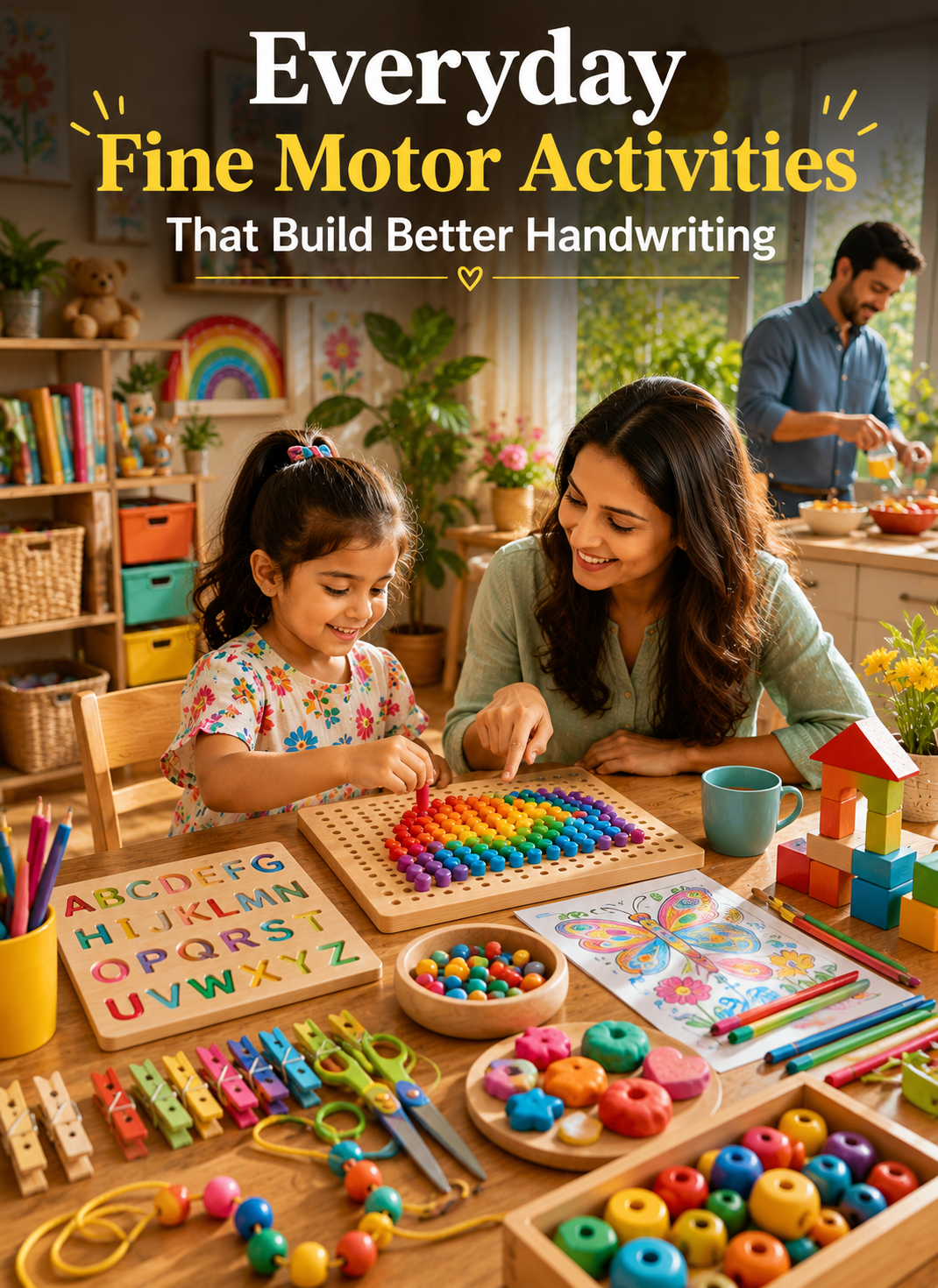
Sample Daily Routines by Age
The table below shows example 10-minute home routines by age group, drawn from common OT suggestions and family education resources
| Age | Example daily routine (10 minutes) |
|---|---|
| 3–4 years | 2–3 minutes of playdough squeezing, rolling, and making simple shapes; 3 minutes pegging clothes or placing pegs into a peg board; 3–4 minutes of drawing big lines and circles on a vertical surface (easel, window with washable markers) |
| 5–6 years | 3 minutes of hand-strength activities (playdough, Theraputty, sponge squeezing); 3 minutes cutting along simple lines and shapes; 4 minutes writing names or short words on a slightly tilted surface or whiteboard [] |
| 7–8 years | 3 minutes of whole-body warm-up (animal walks, wall push-ups); 3 minutes copying and extending peg board or block patterns; 4 minutes writing one or two sentences with a focus on legibility and spacing rather than speed |
| 9+ years | 3 minutes of posture and hand warm-up (stretching, hand exercises); 3 minutes of more complex fine-motor tasks (tying, threading, drawing small details); 4 minutes of timed writing practice focused on clarity and self-check (e.g., “Name, date, spaces, punctuation”) |
Families can adapt these ideas based on their child’s interests and current skills, keeping the overall pattern of “warm-up, fine-motor play, brief writing” as a simple structure.
How Home Routines Connect to the Rest of This Series
Each part of the daily routine can be linked directly to topics you have already explored. Hand-strengthening and peg activities support grip and proprioception, helping with pencil pressure and endurance in the “Proprioception and Pencil Pressure” article Pattern-building with blocks or peg boards feeds into praxis and motor planning, supporting the “think, plan, do” sequence described in your praxis guide
Vertical drawing surfaces and ball games support bilateral coordination and hand-eye coordination, echoing the skills described in your bilateral and visual-motor posts Meanwhile, short, predictable routines directly exercise executive function skills like attention, working memory, and self-regulation, as described in your executive function and handwriting article [
Building in Sensory and Self-Regulation Supports
Home motor programmes often include sensory-aware suggestions, such as using heavy work (pushing, pulling, carrying) before fine-motor or writing tasks, and offering messy play options for children who benefit from rich tactile input . Movement breaks, swinging, or simple obstacle courses can support vestibular input and regulation for more active children before they sit down to write
Families are encouraged to notice what helps their child feel calm and organised, then weave those activities into the daily routine, whether that is a brief movement game before homework, a tactile warm-up like tracing chalk letters with a wet sponge, or a quiet corner with fewer distractions to complete short writing tasks
Frequently Asked Questions
How much time should we spend on fine-motor practice at home?
Most guidelines suggest short, regular sessions of about 5–10 minutes on most days, rather than long, tiring practice blocks.
Do we need special equipment?
No. Household items like pegs, playdough, containers, sponges, and cardboard, plus simple toys like peg boards, provide plenty of fine-motor opportunities.
Should we focus more on writing or on play?
A mix works best. Use playful activities to build strength and coordination, and include a little actual writing so children see how their efforts connect to real tasks.
How do we know if home routines are helping?
Look for gradual changes in grip, endurance, neatness, and confidence over weeks, and maintain communication with your child’s teacher or OT about progress.
When should we ask an OT for a personalised home programme?
If handwriting or self-care skills are significantly behind peers or causing distress, consult an occupational therapist for tailored assessment and home strategies.
Related reading:
- Sensory-Friendly Classrooms and Handwriting: Classroom Supports for Fine Motor Skills
- Executive Function and Handwriting: Attention, Memory, and Fine Motor Skills
- Praxis and Motor Planning in Children: Development, Activities, and Milestones
- Proprioception and Pencil Pressure: Why Kids Write Too Hard or Too Light
- Bilateral Coordination in Children: Development, Activities, and Milestones
- Hand-Eye Coordination in Children: Visual-Motor Development by Age
- Hand Dominance in Children: When It Develops and Why You Shouldn't Choose
- Crossing the Midline in Children: Why It Matters for Writing and Coordination
- Tactile Sensitivity and Fine Motor Skills: Helping Kids Who Avoid or Crave Touch
- Sensory-Friendly Fine Motor Routine: Daily Activities That Help Kids Focus
- Vestibular Input and Fine Motor Skills: Helping Active Kids Focus Through Movement
- Sensory Seekers and Fine Motor Skills: Helping Kids Focus Through Movement
- Fine Motor Milestones Birth to Age 5: Complete Development Chart
Ready to weave fine-motor practice into everyday family life? Our Educational Peg Boards make it easy to add pattern-building and hand-strengthening into short daily routines at home.
Shop Educational Peg Boards Visit Our Google Business ProfileMontessori Toys Team
We research child development guidelines to help families choose toys and routines that genuinely support learning at every stage.