
By Montessori Toys · Updated July 2026 · 17 min read
Handwriting Success Stories: How Families, Teachers, and OTs Work Together to Improve Fine Motor Skills
In this guide:
Why Stories About Handwriting Progress Matter
Research on handwriting interventions highlights the value of collaborative approaches that actively involve parents, teachers, and occupational therapists, with clear communication and shared goals . Parents often feel more confident and engaged when they can see how other families have navigated similar challenges and what helped in real life.
Studies of school-based OT and home programmes show that progress is strongest when practice happens across contexts—therapy sessions, classroom tasks, and everyday home routines—rather than being limited to a clinicThe following composite stories are based on common patterns described in these sources and in clinical guidance.
Case 1: The Reluctant Writer
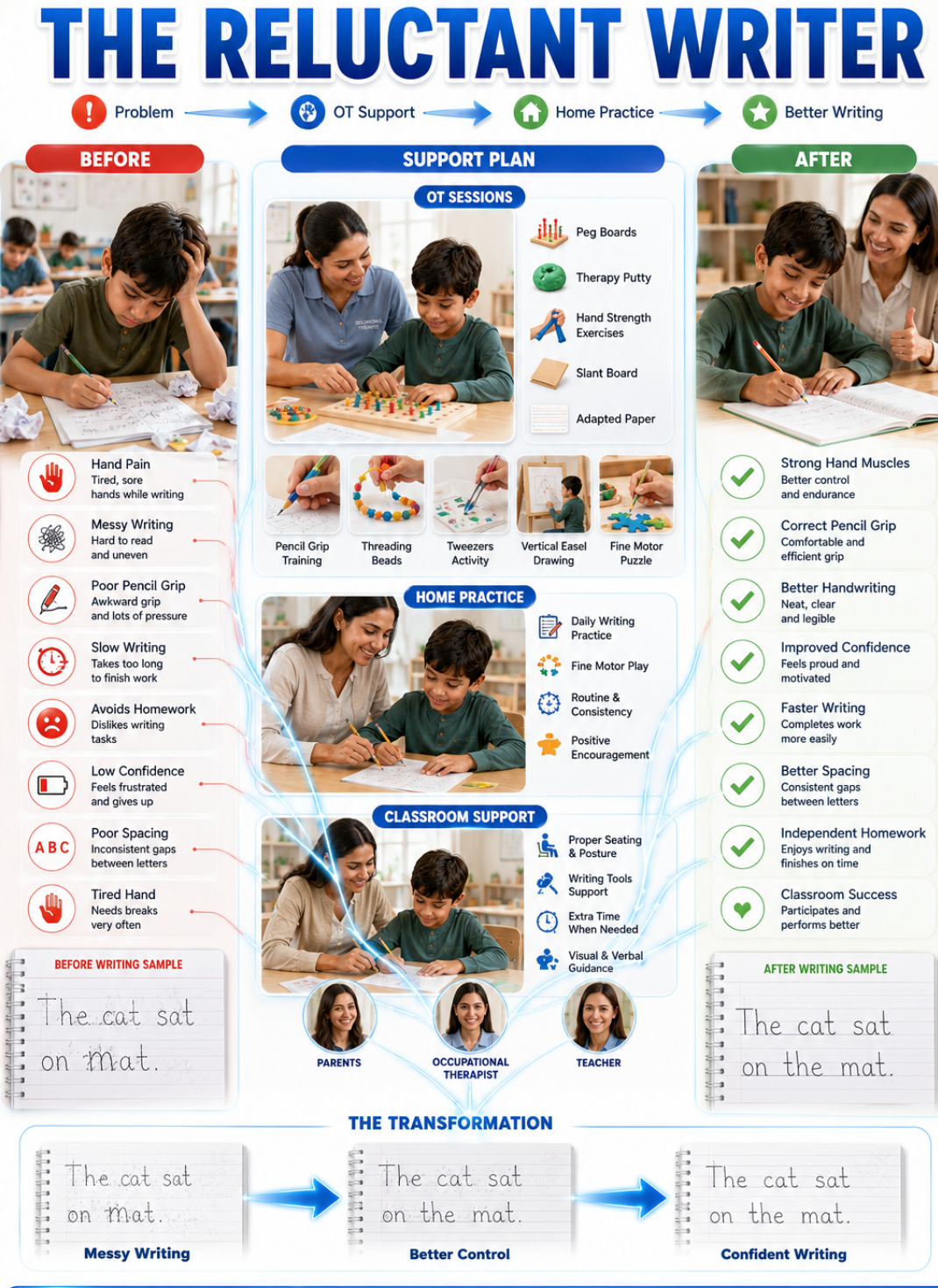
Background: A 7-year-old could express ideas clearly in conversation but avoided written work, wrote very slowly, and complained of hand pain. Teachers reported that written tasks did not reflect the child’s true understanding, and homework often ended in tears [.
Supports used: The school OT assessed posture, grasp, and visual-motor skills, then recommended whole-body warm-ups, hand-strengthening, short timed writing tasks, and classroom accommodations like slant boards and adapted paper. At home, parents introduced a 10-minute routine with playdough, peg boards, and writing short sentences from daily life, focusing on clarity and effort rather than speed .
Outcomes: Over several months, the child’s grip matured, letters became more consistent, and spacing improved. Writing speed increased modestly, but more importantly, the child could complete classroom writing tasks with less fatigue and resistance, and felt proud of clearer work
Case 2: The Sensory Seeker
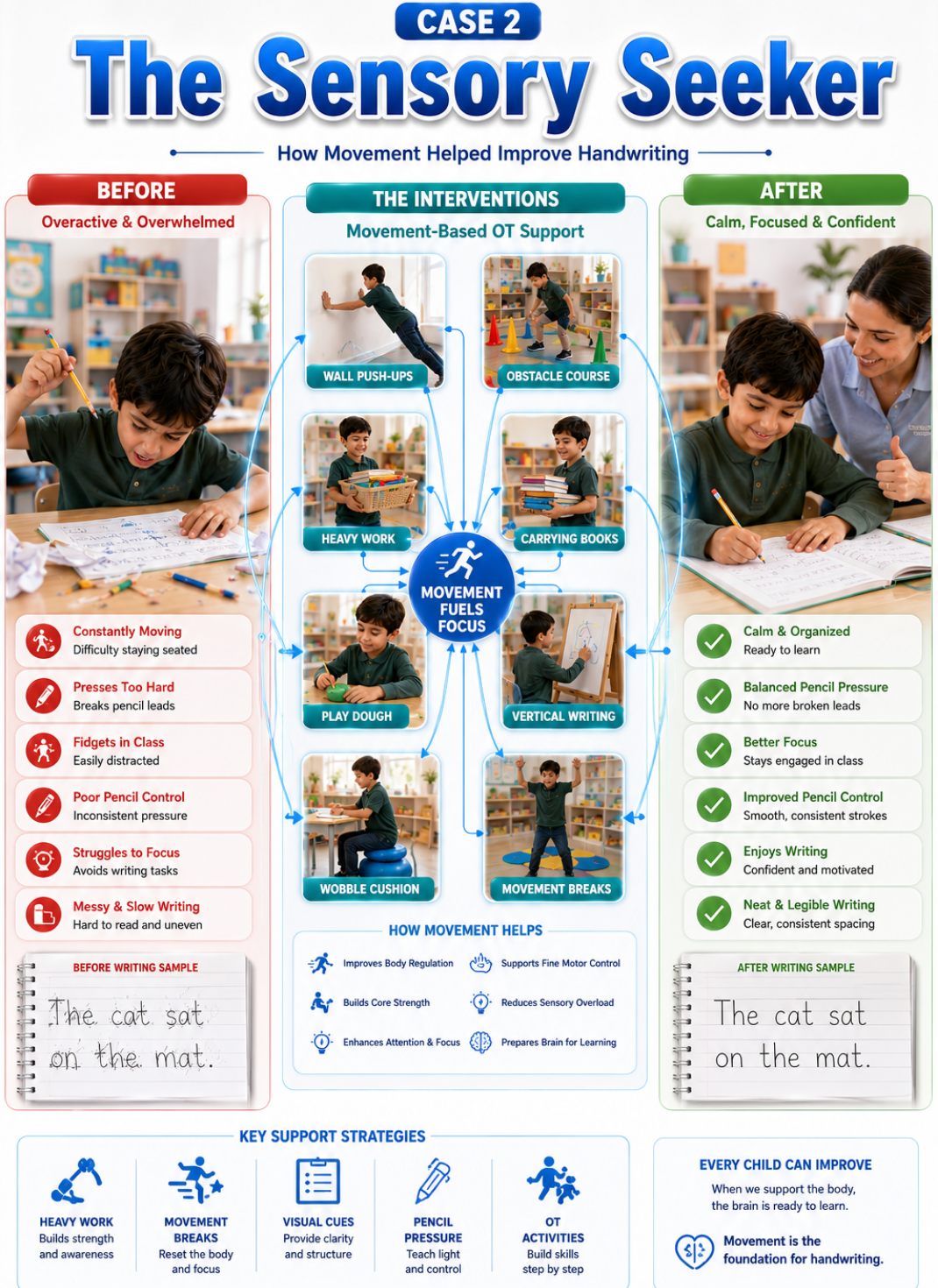
Background: An active 6-year-old craved movement, had difficulty staying seated, and often pressed too hard with the pencil, tearing paper and tiring quickly. Teachers noted frequent fidgeting and difficulty focusing during handwriting lessons
Supports used: The OT and teacher introduced sensory-friendly classroom strategies, including movement breaks, heavy-work activities (wall push-ups, carrying books), a wobble cushion, and visual cues for pencil pressure . At home, parents set up a short routine with obstacle courses, playdough, and vertical writing on windows to channel movement before sitting down for brief writing practice
Outcomes: With consistent use of movement and heavy work before writing, the child could stay seated a bit longer and use more appropriate pencil pressure, leading to fewer broken leads and clearer letters. Teachers reported improved participation in handwriting lessons and less disruptive fidgeting, while parents noticed that homework became more manageable.
Case 3: Fine-Motor Delay and Self-Care Challenges
Background: A 5-year-old struggled with using cutlery, buttoning, and cutting with scissors, and avoided drawing and colouring. Teachers and parents noticed that fine-motor tasks were consistently harder than for peers, raising concerns about future handwriting
Supports used: After an OT assessment, the family received a home programme focused on play-based fine-motor tasks: threading, peg boards, tearing and crumpling paper, simple crafts, and practising dressing fasteners, all fitted into daily routines ]. The preschool classroom added more opportunities for bilateral activities and fine-motor centres, following OT guidance
Outcomes: Over a school year, the child’s hand strength and coordination improved, self-care tasks became faster and more independent, and the child began to enjoy drawing and early writing. When formal handwriting teaching started, the child had a stronger foundation and needed fewer accommodations than initially expected
Supports Used and Outcomes at a Glance
The table below summarises key supports and outcomes across these types of cases, echoing findings from collaborative handwriting intervention research
| Main supports | Typical outcomes over time |
|---|---|
| Collaborative OT–teacher–parent planning | Clear shared goals, consistent strategies across home, school, and therapy, and better parent engagement in handwriting intervention |
| Classroom accommodations (seating, paper, movement) | Improved comfort at the desk, more sustained participation in writing tasks, and gradual gains in legibility and output |
| Home routines and home programmes | Stronger fine-motor foundations, better carryover of OT strategies, and more confident practice in everyday task |
| Multisensory and play-based handwriting activities | Improved letter formation, spacing, and memory for letter shapes, with higher engagement compared to repetitive copying alone |
Related Reading
Explore the rest of the series:
- Fine Motor and Handwriting FAQ: OT Progress and Parent Questions Answered
- Handwriting Progress Over Time: Fine Motor Development and OT Support
- Home Routines for Fine Motor and Handwriting: Daily Activities That Work
- Sensory-Friendly Classrooms and Handwriting: Classroom Supports for Fine Motor Skills
- Executive Function and Handwriting: Attention, Memory, and Fine Motor Skills
- Praxis and Motor Planning in Children: Development, Activities, and Milestones
- Proprioception and Pencil Pressure: Why Kids Write Too Hard or Too Light
- Bilateral Coordination in Children: Development, Activities, and Milestones
- Hand-Eye Coordination in Children: Visual-Motor Development by Age
- Hand Dominance in Children: When It Develops and Why You Shouldn't Choose
- Crossing the Midline in Children: Why It Matters for Writing and Coordination
- Tactile Sensitivity and Fine Motor Skills: Helping Kids Who Avoid or Crave Touch
- Sensory-Friendly Fine Motor Routine: Daily Activities That Help Kids Focus
- Vestibular Input and Fine Motor Skills: Helping Active Kids Focus Through Movement
- Sensory Seekers and Fine Motor Skills: Helping Kids Focus Through Movement
- Fine Motor Milestones Birth to Age 5: Complete Development Chart
Ready to create your own success story? Our Educational Peg Boards are designed to support many of the fine-motor and pattern skills highlighted in these cases, making it easier to build progress through play at home or in the classroom.
Shop Educational Peg Boards Visit Our Google Business ProfileMontessori Toys Team
We turn child development research and therapy experience into practical stories that help families and teachers see what progress can look like.