

By Montessori Toys · Updated July 2026 · 17 min read
Handwriting Red Flags by Age: When to Watch, Support, or Ask for OT Help
In this guide:
- Why red flags are patterns, not one bad day
- Ages 4–5: Early pre-writing and drawing
- Ages 5–7: Learning letters and simple sentences
- Ages 7–9: Longer sentences and small paragraphs
- Ages 9–12: Paragraphs, note-taking, and exams
- When to watch, support more, or ask for OT help
- How to use this series for next steps
Why Red Flags Are Patterns, Not One Bad Day
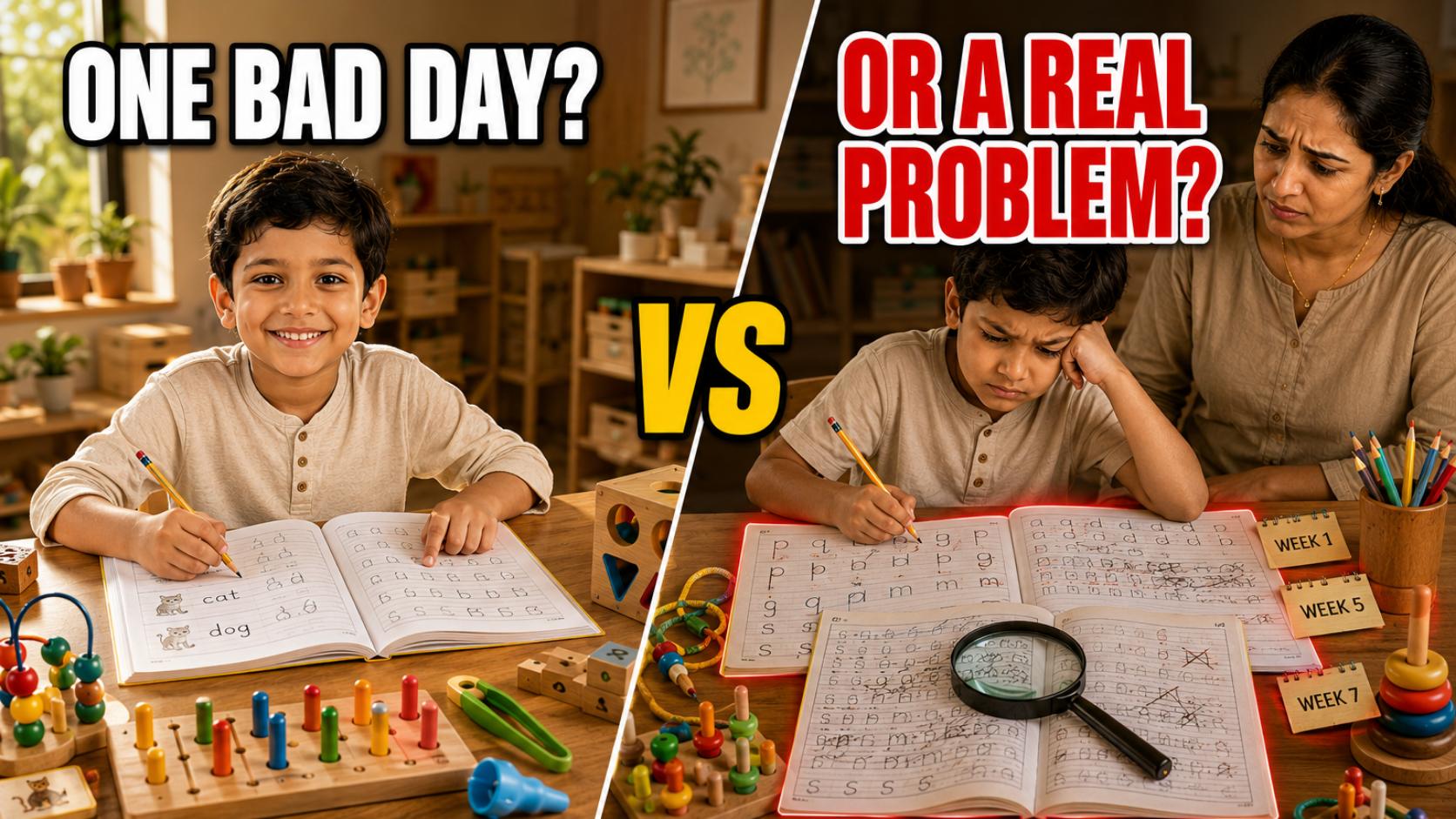
Children of all ages have off days: a rushed worksheet, a wobbly line, or a page full of smudges after a long school day. These moments can feel worrying, but by themselves they are not red flags.
Red flags are patterns that show up again and again over weeks or months, across different settings such as home and school. When you look at comfort, speed, legibility, and the child’s emotions together—and compare them with what is typical for their age—it becomes easier to see whether you can simply watch and support at home, or whether it might be time to speak with a teacher or occupational therapist.
For a deeper look at expectations and common worries, you can pair this guide with your Fine Motor and Handwriting FAQ, Handwriting Progress Over Time article, and your myths blog, Handwriting Myths for Children: Fine Motor Facts Every Parent Should Know.
Ages 4–5: Early Pre-Writing and Drawing
At this age, many children are exploring how to hold crayons, markers, and pencils, and how to make lines and shapes. Their drawings and early “writing” are often big, uneven, and full of energy, which is completely normal.
Commonly seen at this age: Children scribble with enjoyment, draw simple people or houses, and may copy lines, circles, or crosses with practice. They are curious about letters and may recognise their own name, but formal handwriting is not the focus yet.
Watch and support: You might notice that your child sometimes avoids drawing, switches hands often, or needs help holding the paper steady. Gentle encouragement, lots of play-based fine-motor activities, and time to explore different tools usually help.
Potential red flags: A child who consistently refuses any drawing or pre-writing, becomes very distressed with fine-motor tasks, struggles to hold any tool, or has great difficulty crossing the midline or using either hand for simple self-care may need closer attention. Using your Fine Motor Milestones Birth to Age 5 chart, Hand-Eye Coordination, Hand Dominance, and Crossing the Midline articles can help you see whether these patterns match typical development or suggest that extra support might be useful.
Ages 5–7: Learning Letters and Simple Sentences
Between ages five and seven, many children begin formal handwriting instruction and practise forming letters, words, and short sentences. This stage often brings a lot of variation as children balance learning letter shapes, remembering where to start, and thinking about what they want to write.
Commonly seen at this age: Letter reversals, uneven sizes, and irregular spacing are typical. Writing can be slow, and children may still need reminders about how to hold a pencil, where to start letters, and how to sit at the table.
Watch and support: It is worth watching more closely if your child writes noticeably slower than classmates, tires quickly, complains about hand discomfort, or finds it very hard to copy from the board or a nearby worksheet. Simple supports from your Fine Motor and Handwriting Toolkit and Home Routines blog—such as shorter pencils, adapted paper, and brief daily practice—can make these tasks easier.
Potential red flags: A stronger concern arises when handwriting remains very hard to read even when the child is trying, when they avoid any writing task, or when fine-motor difficulties show up across other activities such as cutting, buttoning, or using cutlery. In these cases, combining your toolkit strategies with guidance from the Bilateral Coordination and Sensory-Friendly Fine Motor Routine posts can help, and you may consider discussing these patterns with the teacher or an occupational therapist.
Ages 7–9: Longer Sentences and Small Paragraphs
By ages seven to nine, many children are expected to write longer sentences and short paragraphs, both in class and for homework. Handwriting tasks now ask them to combine spelling, grammar, ideas, and motor skills for longer stretches of time.
Commonly seen at this age: Handwriting is generally readable, even though it may still look messy when children are rushing or tired. Size and spacing are more consistent than in earlier years, and children can usually copy from the board with practice.
Watch and support: Keep an eye out if your child finds it very hard to keep writing on the line, struggles to copy from the board accurately, or shows large changes in neatness as tasks get longer. They might slow down dramatically, lose their place, or become frustrated when asked to write more than a few sentences.
Potential red flags: If written work is much shorter or simpler than your child’s spoken answers, or if teachers note that writing speed and legibility are affecting marks rather than understanding, these can be important signals. In this case, using your Handwriting Support Plan for Children alongside Sensory-Friendly Classrooms, Executive Function and Handwriting, and Proprioception and Pencil Pressure resources can guide adjustments at home and school and help you decide whether an OT opinion would be helpful.
Ages 9–12: Paragraphs, Note-Taking, and Exams
In the later primary years, children are asked to write longer paragraphs, take simple notes, and complete tests and projects under time limits. How easily they can get their ideas on paper starts to influence confidence and performance across many subjects.
Commonly seen at this age: Handwriting is usually legible, although not always neat. Some children begin to refine their style, experiment with cursive, or use typing for longer tasks. They can often keep up with classroom writing demands with effort and support.
Watch and support: You might notice difficulty keeping up with longer assignments, frequent complaints of hand pain after writing, or handwriting that becomes much harder to read during timed tasks. These signs suggest that expectations may need adjusting, or that alternative formats like typing could be helpful for some tasks.
Potential red flags: More serious concerns include written work that is far below your child’s verbal level, exam marks clearly affected by writing speed or legibility, or persistent avoidance of any handwritten work even when topics are interesting. If these patterns appear together with ongoing fine-motor challenges in self-care or play, your Print, Cursive, or Typing, Handwriting Success Stories, and Praxis and Motor Planning posts can guide next steps and support discussions with teachers and health professionals.
When to Watch, Support More, or Ask for OT Help
Not every concern needs immediate specialist input. Thinking in three levels—watch, support more, and ask for OT help—can make decisions feel calmer and more organised for families and teachers.
When to watch
Watching is often enough when handwriting is a bit messy but generally readable, progress is slow but visible, and teachers are not overly concerned about its impact on learning. Children in this group may need reminders, extra time, or occasional breaks, but they are able to participate in most tasks.
In this situation, you can keep a small folder of samples every few months and refer back to your Handwriting Myths for Children, Fine Motor and Handwriting FAQ, and Handwriting Progress Over Time articles to check whether your child’s path looks similar to others at their age.
When to increase support
It is time to increase support when you see ongoing difficulty across different fine-motor tasks, frequent frustration or tears, or progress that seems slower than peers despite regular classroom teaching. These children often benefit from structured home routines, simple tools, and small classroom adjustments.
You can use your Fine Motor and Handwriting Toolkit, Home Routines, Sensory-Friendly Classroom, and Executive Function resources to create a clear plan. Short daily routines, seating and paper changes, and visual supports can make handwriting more manageable while you continue to watch how things evolve.
When to ask for OT help
Consider speaking with an occupational therapist when handwriting difficulties clearly affect schoolwork, cause ongoing distress, or occur alongside broader motor or self-care challenges. Signs include very slow writing, work that is hard to read even with support, strong avoidance, or major difficulty with tasks like buttons, zips, and cutlery.
Bringing a small selection of writing samples and your completed Handwriting Support Plan to an appointment can give the OT a clear picture of your child’s strengths, challenges, and what you have already tried. They can then refine your plan, suggest targeted activities, and coordinate with the school using the same language and strategies you see across your series.
How to Use This Series for Next Steps
Once you have a sense of where your child is and which red flags, if any, apply, you can choose one or two next steps instead of trying to do everything at once. Start with the area that seems to affect your child most—fine-motor strength, sensory responses, classroom demands, or overall mindset about writing.
For sensory concerns, your Tactile Sensitivity, Sensory-Friendly Fine Motor Routine, Vestibular Input, and Sensory Seekers posts offer practical ways to adjust environments and routines. For motor concerns, you can draw on Praxis, Bilateral Coordination, Hand Dominance, Hand-Eye Coordination, and Fine Motor Milestones, and for classroom and planning questions, your Handwriting Support Plan, Sensory-Friendly Classroom, Executive Function, and Print vs Cursive vs Typing guides provide clear structures to follow.
Ready to respond to red flags with calm, practical steps? Our Educational Peg Boards and fine-motor toys give you simple, engaging ways to support handwriting skills at home and in the classroom.
Shop Educational Peg Boards Visit Our Google Business ProfileMontessori Toys Team
We help families and teachers recognise handwriting red flags early and turn them into clear, realistic action plans for home and school.