

By Montessori Toys · Updated July 2026 · 16 min read
Handwriting Myths and Mindset: Rethinking “Lazy,” “Messy,” and “Not Trying” in Children’s Writing
In this guide:
- Why mindset about handwriting matters
- Myth 1: “They’re lazy or not trying”
- Myth 2: “More practice will fix everything”
- Myth 3: “Messy handwriting means low intelligence or no effort”
- Myth 4: “We must fix fine-motor and sensory issues before writing”
- Myth 5: “Messy writing always means big problems”
- Myth 6: “Changing grip, cursive, or typing will fix everything”
- Myth 7: “They’ll just grow out of it”
- Related reading
Why Mindset About Handwriting Matters
How adults think and talk about handwriting shapes how children feel about themselves as learners. If a child keeps hearing that they are “lazy,” “messy,” or “not trying,” they may begin to believe they are bad at school overall, even when their ideas are strong.
When adults instead see handwriting difficulties as a mix of skills, practice, and environment, they are more likely to set realistic expectations, provide helpful supports, and notice progress that might otherwise be missed. This mindset shift also makes it easier to create and follow a clear handwriting support plan at home and school.
Myth 1: “They’re Lazy or Not Trying”
Many children avoid writing or rush through it because it feels genuinely hard, uncomfortable, or overwhelming, not because they are lazy. Handwriting can be tiring when fine-motor strength, coordination, posture, or sensory regulation are still developing.
More helpful mindset: “If my child is resisting writing, something about this task is too hard right now or not well-matched to their skills.” Adults can respond by adjusting how much is written, giving extra support at the start of a task, or breaking work into small steps, rather than adding more pressure or criticism.
Try saying instead: “This looks like a big job. Let’s decide what part you’ll write and what part we’ll do together,” or “I can see you’re working hard, even if the letters don’t look how you want yet.”
Myth 2: “More Practice Will Fix Everything”
Simply writing more of the same way does not always help; it can reinforce unhelpful habits and increase frustration. Children need practice that is short, specific, and matched to their current abilities, with a clear focus such as size, spacing, or stamina.
More helpful mindset: “Practice helps when we know what we’re practising and why.” Instead of asking a child to copy pages of words, families and teachers can focus on one or two goals at a time—such as keeping letters on the line or writing for a set number of minutes—and give feedback on that specific skill.
Try saying instead: “Today we’ll pay attention just to keeping the letters on the line,” or “Let’s write for three minutes and see how your hand feels, then take a break and do a different activity.”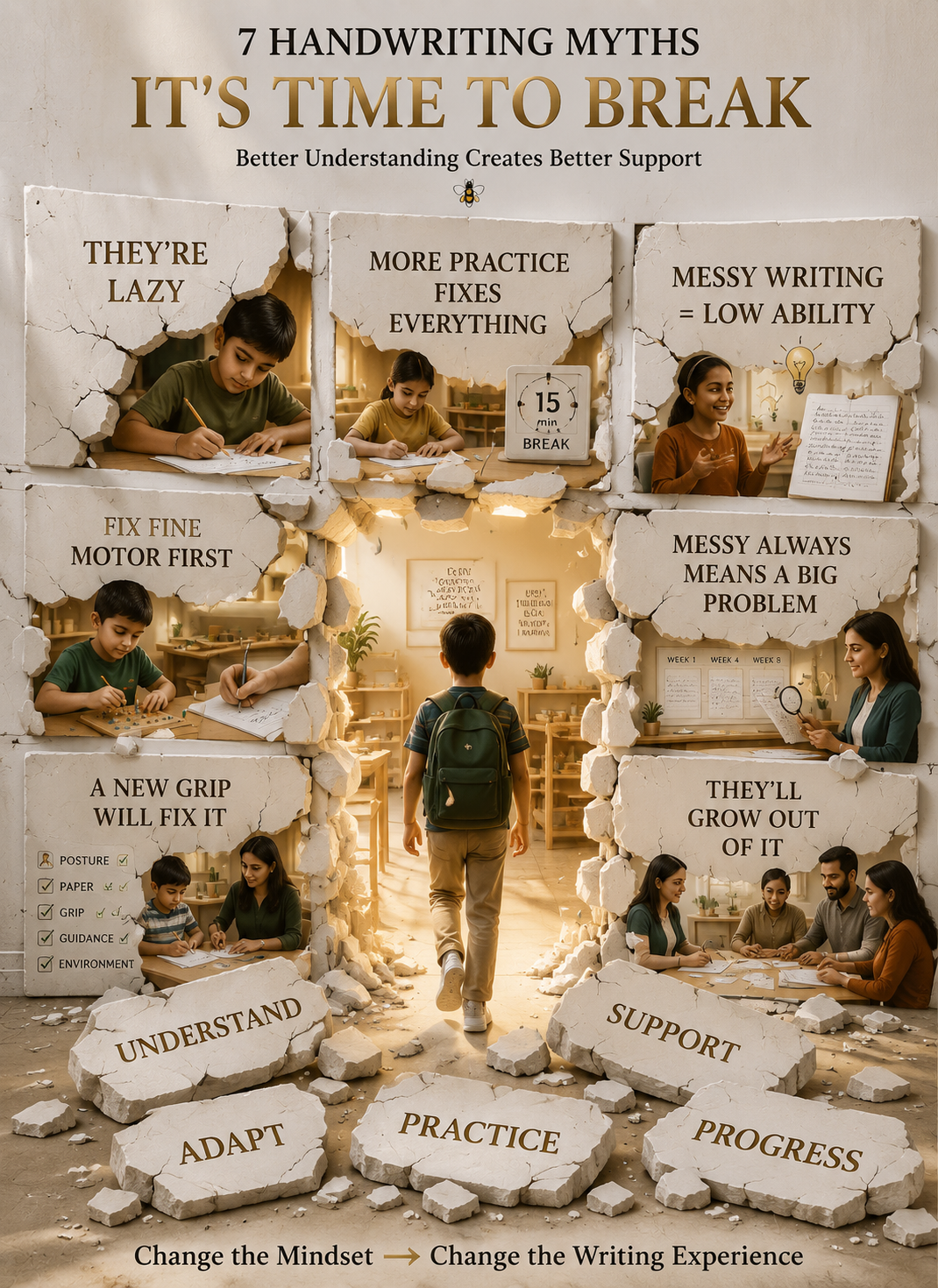
Myth 3: “Messy Handwriting Means Low Intelligence or No Effort”
Many bright children have messy handwriting, especially when they are thinking quickly or juggling multiple demands like spelling, grammar, and ideas. Some children with dysgraphia or fine-motor challenges can express detailed thoughts verbally but struggle when asked to write them down.
More helpful mindset: “Handwriting shows how easily a child can put ideas on paper, not how intelligent they are.” When adults separate the quality of the writing from the quality of the child’s thinking, they can better support both—using tools like oral answers, typing, or shared writing while also working on handwriting skills over time.
Try saying instead: “You have great ideas; let’s figure out how to get them onto the page,” or “We’re working on making your handwriting easier to read so others can see how much you know.”
Myth 4: “We Must Fix Fine-Motor and Sensory Issues Before Writing”
Fine-motor skills, sensory processing, and handwriting usually grow together over time, rather than in a strict step-by-step order. Waiting until every underlying skill is “fixed” before allowing a child to write can delay their confidence and experience with real-world tasks.
More helpful mindset: “We can build fine-motor and sensory skills while also supporting real writing tasks.” Adults can blend activities like peg boards, playdough, and movement breaks with short, meaningful writing practice so children experience success in both areas.
Try saying instead: “First we’ll warm up your hands and body, and then we’ll write one sentence,” or “We’re working on your muscles and your writing at the same time.”
Myth 5: “Messy Writing Always Means Big Problems”
Some children simply write quickly or with less focus at certain ages, especially when tasks feel boring or rushed. Others do have ongoing fine-motor, sensory, or learning needs that make handwriting consistently difficult and slow.
More helpful mindset: “Messy writing is a signal to look more closely, not an automatic sign of a serious problem.” Adults can watch for patterns over time—such as pain, extreme slowness, strong avoidance, or difficulty across many tasks—and use those observations to decide whether extra support or an occupational therapy referral might be helpful.
Try saying instead: “Some of this looks rushed; let’s slow down one line and see what changes,” or “Your writing is hard to read right now, but we can practise one small thing to help it improve.”
Myth 6: “Changing Grip, Cursive, or Typing Will Fix Everything”
Pencil grips, different paper, cursive writing, or typing can be very helpful tools for many children, but they are not magic solutions. These supports work best when they are part of a wider plan that also considers posture, sensory needs, task length, and how instructions are given.
More helpful mindset: “Tools and formats are part of the solution, not the whole answer.” For some children, learning cursive reduces letter reversals; for others, typing makes longer writing possible while handwriting skills slowly improve in shorter tasks.
Try saying instead: “Let’s see if this pencil grip or paper makes it easier for you,” or “You can type the long assignment and handwrite a short paragraph so we can practise both skills.”
Myth 7: “They’ll Just Grow Out of It”
Some children do catch up with handwriting as their muscles, coordination, and attention mature, especially when demands are reasonable and they get time to practise. However, when difficulties are strong and persistent, or when writing clearly affects schoolwork and self-confidence, children often need more structured help.
More helpful mindset: “We’ll watch progress and respond early if writing continues to be very hard.” Families and teachers can track short samples over time, adjust expectations, and seek advice from an occupational therapist or school team when progress stalls or worries increase.
Try saying instead: “Let’s see how your writing changes over the next few months,” or “We’ll ask for extra help so you don’t have to struggle alone.”
Bringing it all together
When adults move away from myths and toward a more compassionate, skill-based view of handwriting, children are more likely to feel safe enough to practise and to notice their own progress. Combined with a clear handwriting support plan, the right tools, and realistic expectations, this mindset can transform writing from a daily battle into a manageable, step-by-step journey.
Ready to support your child’s handwriting with less stress? Our Educational Peg Boards and fine-motor toys give you simple, engaging ways to build the skills behind handwriting at home and in the classroom.
Shop Educational Peg Boards Visit Our Google Business ProfileMontessori Toys Team
We help families and teachers turn complex handwriting and fine-motor information into simple routines and tools that children can actually use every day.