
Print, Cursive, or Typing? How Fine Motor Skills Guide When and How Children Move Between Writing Styles
In this guide:
Why Writing-Style Decisions Matter
Guidance for parents and schools emphasises that the style of writing—print or cursive—should be chosen with legibility and comfort in mind, taking into account the child’s preferences and abilitiesFor some children, pushing cursive before print is clear can make writing more stressful, while others may find the continuous flow of cursive actually easier once the basics are in place.
Occupational therapy practice increasingly recognises that typing and assistive technology can play a role when handwriting difficulties significantly impact academic progress, particularly in older children, but that strong fine-motor foundations are still valuable for daily tasks and signatures . The goal is to match the right mix of print, cursive, and typing to each child rather than insisting on a single path.
Print First: Building a Clear Foundation
Most programmes begin with print because it is visually simple and widely used in early reading and worksheets. OT resources stress the importance of consistent letter formation, sound spacing, and alignment within lines or boxes before adding extra demands like joins Building this foundation involves posture, pencil grasp, visual-motor skills, and fine-motor strength, which you have explored throughout this series.
Children who still struggle with basic print legibility may benefit from focused support—home routines, classroom accommodations, and OT—before cursive becomes a major expectation. In many cases, improving print first leads to more confident transitions to cursive or to more effective use of typing later, because core motor and visual skills are already more secure
When and How to Introduce Cursive
Evidence-informed OT guidance suggests introducing cursive once children can form most print letters consistently, maintain a functional grasp, and manage short print writing tasks with reasonable stamina. Cursive adds demands for smooth letter connections, rhythm, and more complex motor planning, but it can also support reading fluency and reduce some spacing problems because letters stay connected in words .
Many OT-led cursive programmes group letters by movement patterns (e.g., similar starting strokes) and use multisensory strategies—tracing, air writing, fine-motor art—to make learning more engaging ]. Children with significant motor or visual-motor challenges may need slower pacing, selected cursive targets (such as their name and common words), or may rely primarily on well-supported print plus alternative ways to show learning.
When to Bring in Typing and Technology
Occupational therapists working with older children often consider typing and digital tools when handwriting difficulties continue to hamper academic performance despite good support. Typing shifts some demands from fine-motor precision to finger coordination and visual scanning of the keyboard and screen, and can reduce fatigue for lengthy written work.
Practice recommendations suggest teaching basic keyboarding skills once children can follow simple patterns and manage visual scanning tasks, while still maintaining opportunities to build fine-motor skills for everyday handwriting needs]. The balance may be different for each child: some use typing mainly for longer assignments, while continuing to handwrite shorter notes and maths work.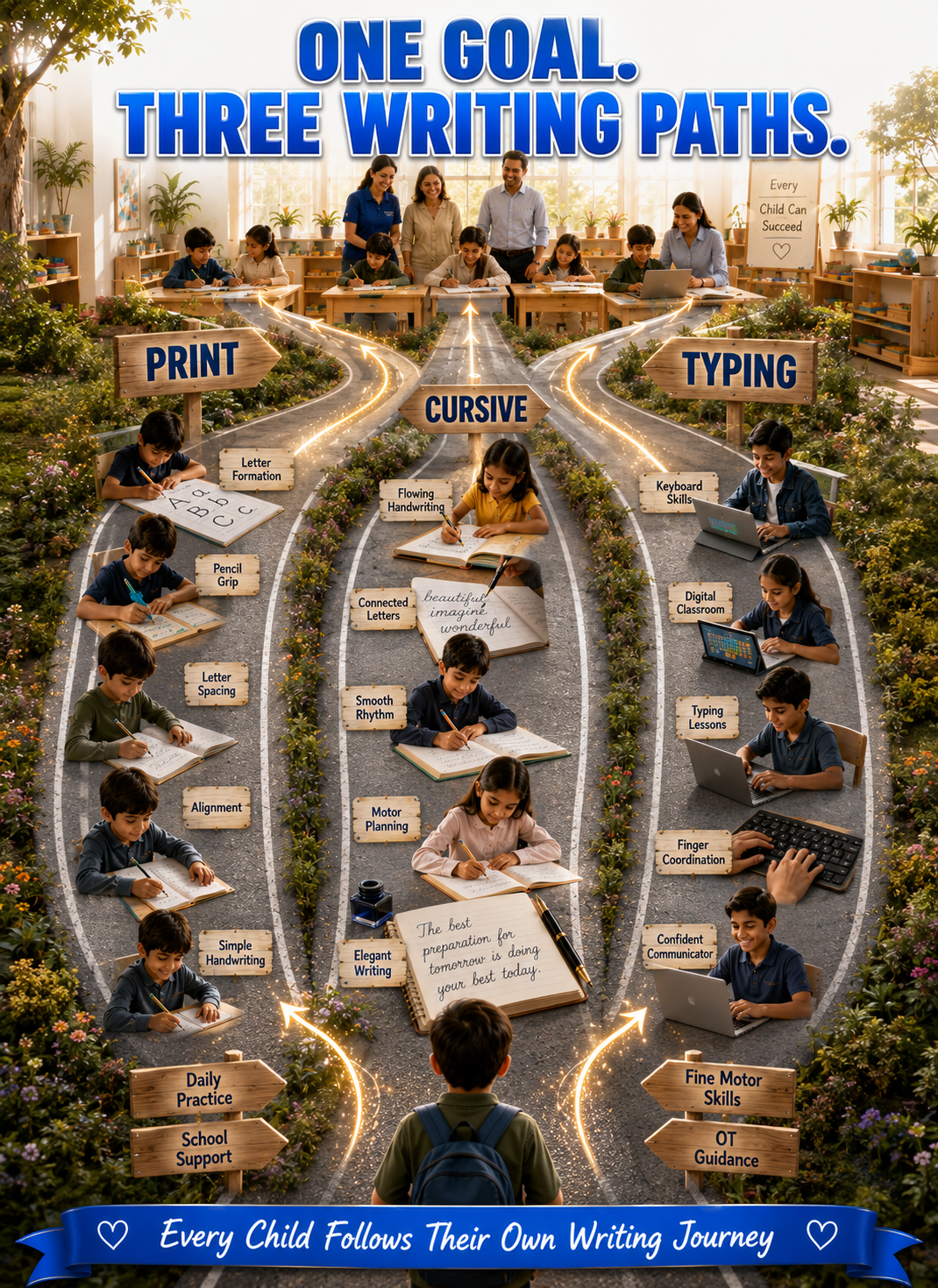
Print, Cursive, Typing: Demands at a Glance
The table below summarises key demands and potential benefits of each writing style, based on OT and school guidance
| Style | Main demands | Potential benefits |
|---|---|---|
| Letter-by-letter formation, spacing between letters and words, alignment to lines or boxes, visual discrimination of similar shapes | Simple and widely used in early reading and worksheets; easier to start; helpful for children who need clear visual separation between letters | |
| Cursive | Continuous letter connections, rhythmic movement, more complex motor planning, consistent slant and size | Can reduce spacing issues, support reading and spelling, and provide smoother, more fluent writing once mastered |
| Typing | Finger coordination, visual scanning of keyboard and screen, posture at a device, basic keyboarding patterns | Reduces fine-motor strain for long tasks, can improve access to written expression for children with significant handwriting difficulties |
Related Reading
Explore the rest of the series:
-
- Handwriting Success Stories: Fine Motor Progress with OT and Family Support
- Fine Motor and Handwriting FAQ: OT Progress and Parent Questions Answered
- Handwriting Progress Over Time: Fine Motor Development and OT Support
- Home Routines for Fine Motor and Handwriting: Daily Activities That Work
- Sensory-Friendly Classrooms and Handwriting: Classroom Supports for Fine Motor Skills
- Executive Function and Handwriting: Attention, Memory, and Fine Motor Skills
- Praxis and Motor Planning in Children: Development, Activities, and Milestones
- Proprioception and Pencil Pressure: Why Kids Write Too Hard or Too Light
- Bilateral Coordination in Children: Development, Activities, and Milestones
- Hand-Eye Coordination in Children: Visual-Motor Development by Age
- Hand Dominance in Children: When It Develops and Why You Shouldn't Choose
- Crossing the Midline in Children: Why It Matters for Writing and Coordination
- Tactile Sensitivity and Fine Motor Skills: Helping Kids Who Avoid or Crave Touch
- Sensory-Friendly Fine Motor Routine: Daily Activities That Help Kids Focus
- Vestibular Input and Fine Motor Skills: Helping Active Kids Focus Through Movement
- Sensory Seekers and Fine Motor Skills: Helping Kids Focus Through Movement
- Fine Motor Milestones Birth to Age 5: Complete Development Chart
Ready to support any writing style with stronger foundations? Our Educational Peg Boards help build the fine-motor strength, coordination, and pattern skills that underpin both handwriting and comfortable use of technology.
Shop Educational Peg Boards Visit Our Google Business ProfileMontessori Toys Team
We help families and schools make practical, child-centred decisions about handwriting and technology, grounded in fine-motor and sensory development.