

Fine Motor and Handwriting FAQ: OT Progress and Parent Questions Answered
In this guide:
Why This FAQ Matters
Parents often hear different opinions about handwriting and fine-motor skills, which can make it hard to know what to do next. Some adults focus on neatness, others on speed, and others on tools or therapy, so families are left trying to sort out what actually helps.
This FAQ brings the most common questions into one place and answers them in a practical, low-stress way. It also works as a helpful companion to your Handwriting Success Stories, Handwriting Progress Over Time, and Handwriting Support Plan for Children posts.
How Long Does Handwriting Progress Take?
Handwriting progress usually happens slowly, in small steps. A child may first become less upset about writing, then stay with the task a little longer, and only later show clearer changes in letter formation or spacing.
The timeline varies based on age, motor development, sensory needs, practice quality, and how much support the child gets at home and school. For many children, the most realistic way to track progress is to compare samples over several weeks or months rather than expecting changes from one practice session to the next.
Is Messy Writing Always a Problem?
No. Messy writing can be part of normal development, especially when children are still learning letter shapes, working quickly, or managing other demands at the same time.
What matters more is whether the writing is gradually improving and whether the child can keep up with classroom tasks without too much pain, frustration, or avoidance. If messy writing is paired with very slow speed, strong distress, or difficulty in other fine-motor tasks, it may be worth looking more closely.
This question connects closely to your Handwriting Red Flags by Age and Handwriting Readiness by Age posts.
Does Practice Make Handwriting Better?
Practice helps most when it is short, specific, and matched to the child’s current skill level. Repeating the same task over and over without guidance can sometimes reinforce the same poor habits and make handwriting feel like a punishment.
Children usually do better when adults focus on one goal at a time, such as letter size, spacing, grip, or stamina. Your Home Routines for Fine Motor and Handwriting and Sensory-Friendly Fine Motor Routine posts are a good match here because they show how to build skill without overload.
Should We Use Print, Cursive, or Typing?
There is no single best answer for every child. Print is often easiest for early learners, cursive may help some children with flow and fluency, and typing can be the best option when hand fatigue or slow speed is limiting written output.
The best choice is the one that helps the child communicate clearly without unnecessary stress. For many families, the answer is a mix: handwriting for short tasks, cursive if it feels easier, and typing for longer assignments or when stamina is the main issue.
This section naturally connects to your Print, Cursive, or Typing article, as well as your Handwriting Support Plan for Children post.
Do Pencil Grips Really Help?
Pencil grips can help some children, but they are not a universal fix. A grip may improve comfort or position, yet it usually works best when combined with posture support, paper adjustments, short practice, and attention to the child’s overall motor needs.
If a child is still struggling after a grip change, that does not mean the tool failed. It may simply mean that the child needs a different setup or a broader support plan, which is where OT and classroom adjustments can be helpful.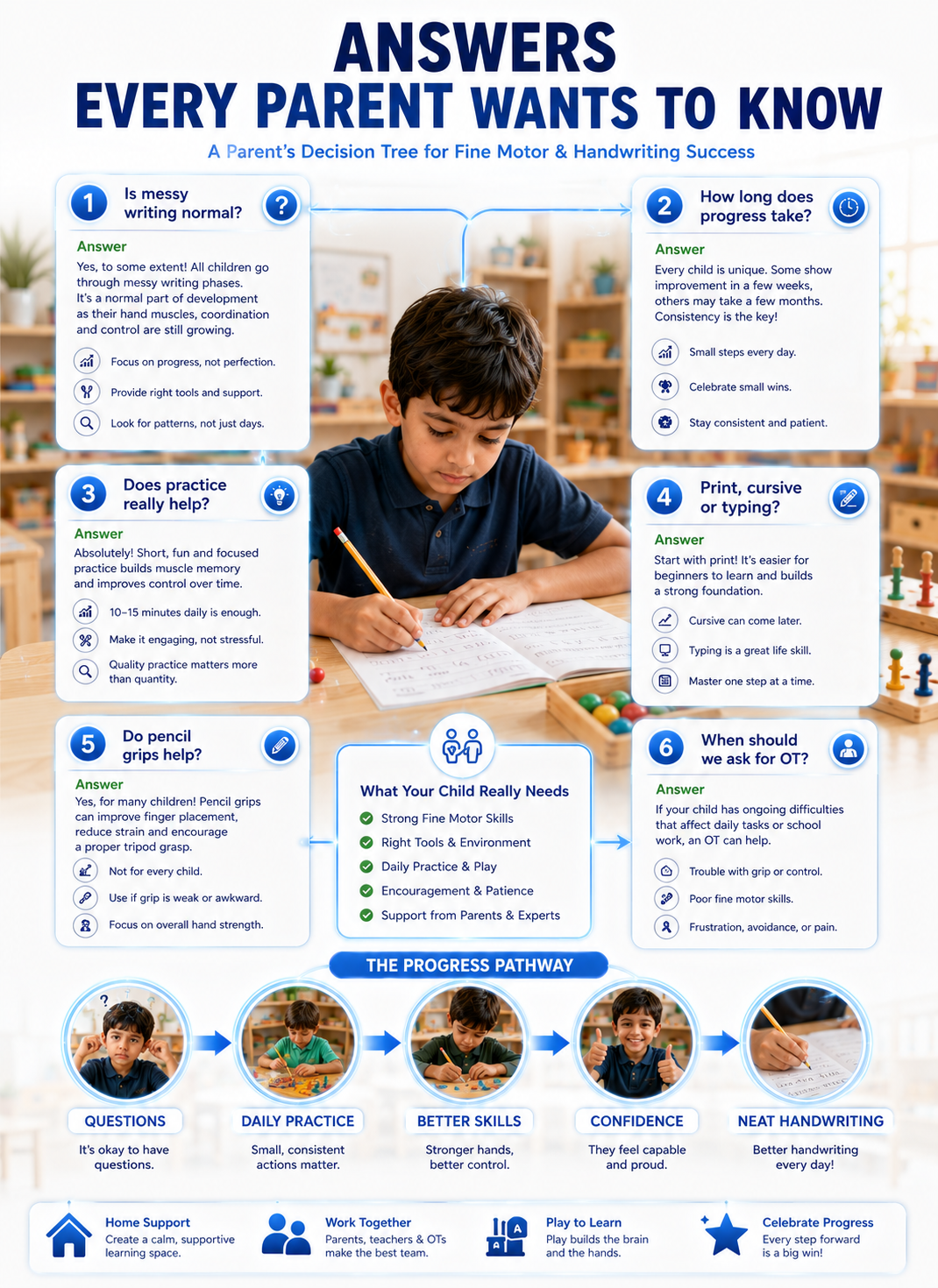
When Should We Ask for OT Help?
Consider occupational therapy when handwriting problems clearly affect learning, participation, comfort, or confidence. This is especially important if the child avoids writing often, writes much more slowly than peers, has frequent hand pain or fatigue, or has other fine-motor concerns such as cutlery use, buttons, or zips.
OT can help identify whether the main issue is motor planning, sensory regulation, visual-motor control, pressure, posture, or a mix of factors. It can also help families and teachers create a support plan that is realistic and consistent across settings.
This is why your Handwriting Red Flags by Age and Handwriting Success Stories posts work well beside this FAQ.
Need practical tools for handwriting support? Our Educational Peg Boards and fine-motor toys help children build the motor skills that make handwriting easier over time.
Shop Educational Peg Boards Visit Our Google Business ProfileMontessori Toys Team
We help families and teachers understand handwriting progress with practical answers, realistic expectations, and simple support strategies.