

By Montessori Toys · Updated July 2026 · 16 min read
Handwriting Readiness by Age: What Skills Children Need Before Writing Becomes Easy
In this guide:
What Handwriting Readiness Means
Handwriting readiness is the set of skills that make writing easier, more comfortable, and less frustrating for a child. It includes posture, shoulder stability, hand strength, visual-motor control, sensory regulation, attention, and the ability to copy or form shapes over time.
Because these skills develop together, there is no single moment when a child is suddenly “ready” for handwriting. Instead, readiness builds gradually through play, movement, drawing, and short writing experiences that match the child’s age and stage.
This idea connects closely to your Fine Motor Milestones Birth to Age 5: Complete Development Chart post, which helps parents see how foundational skills emerge before formal writing becomes easy.
Age 3–4: Pre-Writing Foundations
At three to four years old, the goal is not neat handwriting. The goal is to build the body and hand foundations that later support writing, such as reaching, grasping, moving across the page, and controlling tools during play.
What often looks ready: Enjoys scribbling, makes vertical and horizontal lines, copies simple shapes with help, and uses crayons or markers with growing control. Children at this stage are usually learning through drawing, colouring, building, and other hands-on activities rather than formal letter writing.
How to support: Offer large crayons, chalk, colouring, tracing games, playdough, tongs, and movement-based activities that build shoulder and hand control. For some children, your Hand-Eye Coordination in Children and Crossing the Midline in Children posts will help explain why these early movements matter.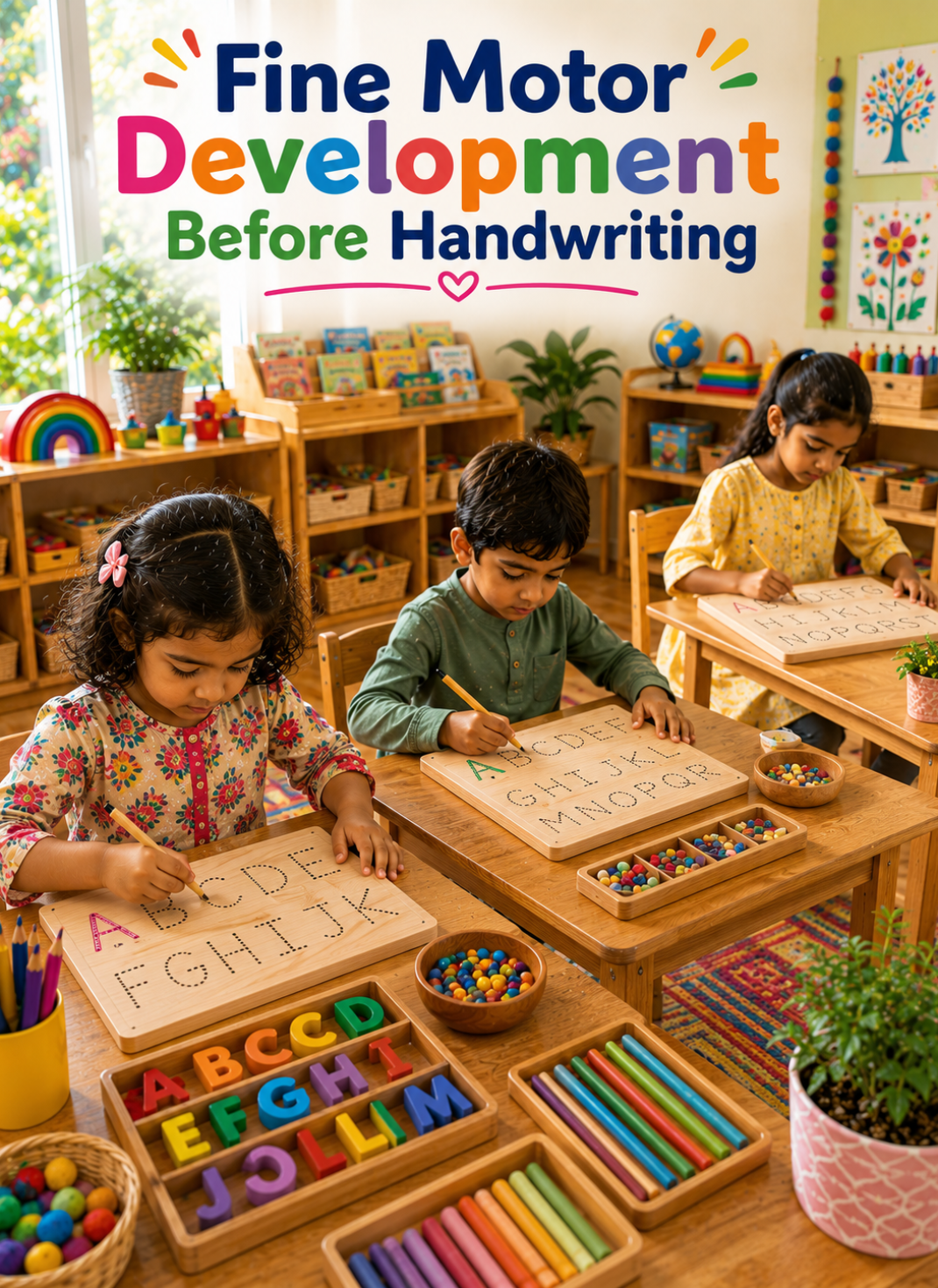
Age 4–5: Early Writing Preparation
By four to five years old, many children are ready to build more control in their hands and begin learning the early shapes that lead into letters. This is often the stage where adults start noticing whether a child can copy shapes, hold a pencil more steadily, and stay interested in short table-top tasks.
What often looks ready: Can copy simple shapes, make more controlled lines, show interest in letters, and follow simple directions in a short activity. They may still use a loose grasp or get tired quickly, but they are building the basic control needed for early writing.
How to support: Keep activities brief and playful. Use tracing, sticker paths, dot-to-dot games, puzzles, and simple craft tasks. Your Hand Dominance in Children and Bilateral Coordination in Children articles fit well here because both skills support more efficient pencil use.
Age 5–7: Early Handwriting Stage
Between five and seven years old, handwriting starts to become a more regular part of learning. Children are now expected to form letters, write words, and manage short sentences, so the demands on their motor, visual, and attention systems increase quickly.
What often looks ready: Can form some letters, copy short words, sit for brief writing tasks, and tolerate a little more practice. Even if the writing is not neat, the child is usually beginning to understand how letters and sounds connect on the page.
How to support: Keep practice short and specific, and make sure the child has the right tools and setup. Your Home Routines for Fine Motor and Handwriting and Fine Motor and Handwriting Toolkit posts are a strong match here because they show families how to create small, repeatable routines that build confidence.
What Readiness Is Not
Readiness is not the same as perfect pencil grip, neat handwriting, or sitting still for a long time. Many children are still developing these skills when they first start formal writing, and that is completely normal.
Readiness is also not a reason to delay all writing until every fine-motor or sensory issue is “fixed.” Children often learn best when they can write a little, play a little, and practise a little, rather than waiting for a perfect set of conditions. This is why your Handwriting Myths for Children and Handwriting Support Plan for Children posts are useful companions to this article.
How to Help Readiness Grow
The best way to build handwriting readiness is through small, regular experiences that strengthen the body, hands, and attention without creating pressure. Daily routines can include movement, sensory input, fine-motor play, and short writing practice.
For example, a child might do a brief movement break, use playdough or tweezers, then write one name, one word, or one short sentence. Your Sensory-Friendly Fine Motor Routine, Tactile Sensitivity and Fine Motor Skills, Vestibular Input and Fine Motor Skills, and Sensory Seekers and Fine Motor Skills posts give parents and teachers practical ways to match activities to each child’s needs.
When to Ask for OT Help
Consider occupational therapy support when handwriting remains very hard, very tiring, or very stressful despite regular practice and reasonable classroom adjustments. It is especially helpful if writing problems appear alongside difficulty with scissors, buttons, cutlery, or other fine-motor tasks.
Your Fine Motor and Handwriting FAQ, Handwriting Progress Over Time, Handwriting Success Stories, and Handwriting Red Flags by Age posts work well here to help families understand when to keep supporting at home and when to ask for extra help.
Need more ways to build readiness? Our Educational Peg Boards and fine-motor toys make it easy to practise the skills that support handwriting through play.
Shop Educational Peg Boards Visit Our Google Business ProfileMontessori Toys Team
We help families and teachers support handwriting readiness through simple, practical routines that fit real-life development.