

Handwriting Red Flags by Age: When to Seek OT Help
In this guide:
What Handwriting Red Flags Mean
Handwriting red flags are not about one bad page or one difficult day. They are repeated patterns that suggest a child may be struggling with the body, hand, visual, sensory, or attention skills needed for writing to feel manageable.
Some children are simply still developing. Others need more support because the work is causing fatigue, frustration, or clear limits on school participation. That is why the age of the child matters so much when you decide what to watch and what to do next.
This topic connects closely to your Handwriting Readiness by Age and Is Your Child Ready to Write? Fine Motor Skills by Age posts, because readiness and red flags are two sides of the same developmental picture.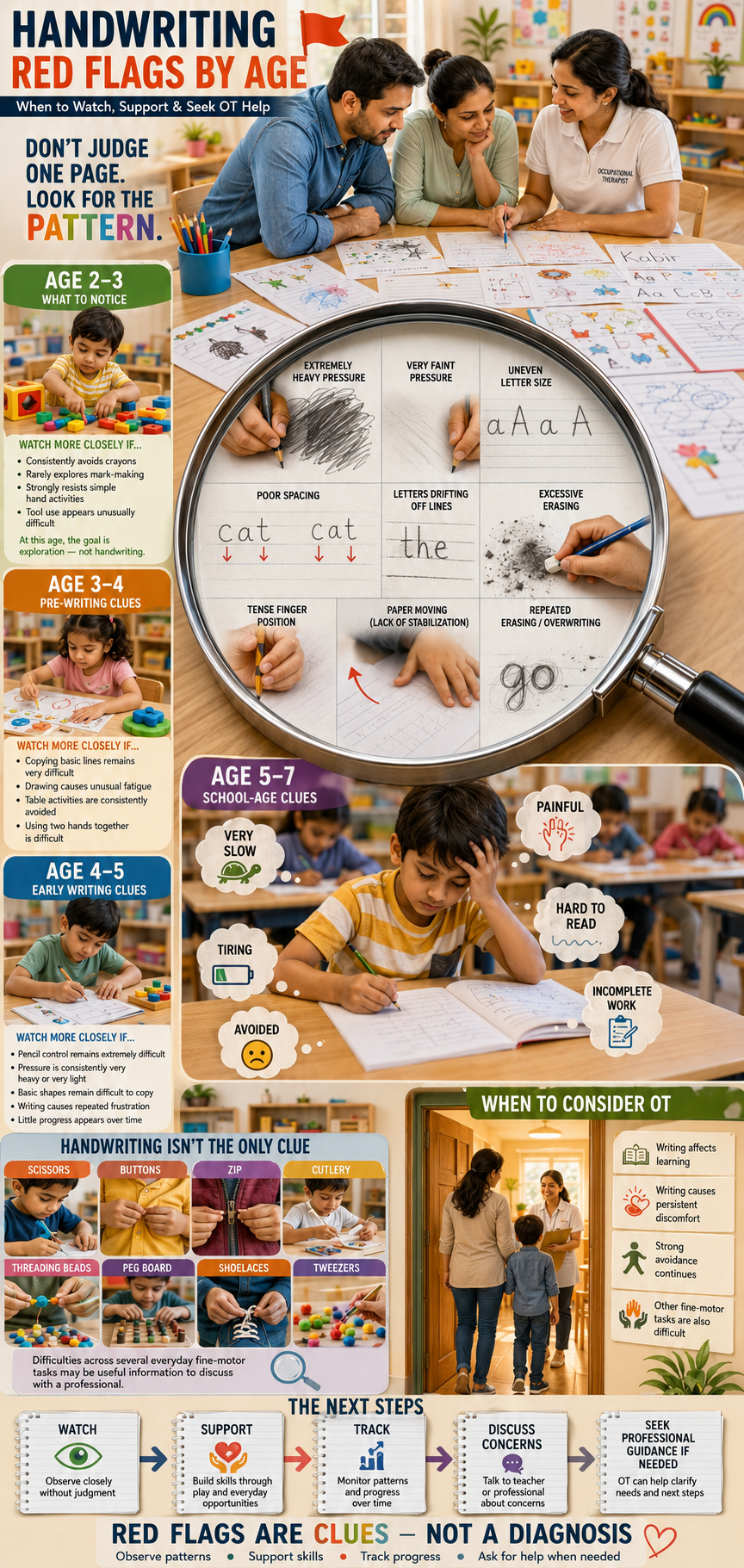
Age 2–3: Early Concern Signs
At age two to three, children are just beginning to explore marks, movement, and tool use. They are not expected to write words, but they should usually be showing some interest in scribbling, drawing, or using both hands in play.
Possible concern signs: Avoids crayons or drawing altogether, uses hands very awkwardly, shows little interest in mark-making, or becomes upset every time a pencil-like tool is offered. If these patterns are strong and consistent, it may be worth watching more closely.
Helpful next steps: Offer large crayons, vertical drawing, playdough, blocks, and simple hand games. Your Writing Readiness for Kids: Fine Motor Skills Ages 2–5 and Fine Motor Milestones Birth to Age 5 posts are useful references at this stage.
Age 3–4: Pre-Writing Concerns
By age three to four, many children are copying lines, drawing simple shapes, and learning to control a tool more intentionally. Red flags at this stage usually show up as strong resistance, poor control, or very limited progress over time.
Possible concern signs: Struggles to copy lines, avoids table tasks, seems unusually tired by drawing, or cannot use both hands together in simple activities. A child who cannot keep the hand steady enough for these early tasks may need extra support.
Helpful next steps: Use tracing games, sticker paths, chalk, and playdough tools. Your Hand-Eye Coordination in Children and Praxis and Motor Planning in Children posts help explain the underlying skills that may be making these tasks hard.
Age 4–5: Early Handwriting Concerns
At four to five years old, children often begin early handwriting practice. Concerns at this age tend to appear when the child still cannot copy basic shapes, has very poor pressure control, or shows no real improvement after repeated practice.
Possible concern signs: Weak pencil control, very tight or very light pressure, frequent frustration, frequent reversals, or difficulty staying engaged for even a short writing task. If writing is always hard, the child may be telling you the underlying skills are not yet ready.
Helpful next steps: Try brief, playful activities and avoid long drills. Your Proprioception and Pencil Pressure, Bilateral Coordination in Children, and Handwriting Progress Over Time posts help frame what normal improvement should look like.
Age 5–7: School-Age Concerns
By ages five to seven, handwriting is usually becoming part of daily learning, so red flags often show up in classwork, homework, and confidence. At this stage, the issue may be more obvious because the child is expected to write more and for longer periods.
Possible concern signs: Writing is very slow, tiring, painful, or hard to read; the child avoids writing; or the amount of work completed is much less than expected. If handwriting is interfering with learning or self-esteem, it is worth taking seriously.
Helpful next steps: Look at posture, spacing, task length, and sensory support. Your Executive Function and Handwriting and Sensory-Friendly Classrooms and Handwriting posts can help readers see why the problem may be broader than just pencil control.
When to Seek OT Help
Consider occupational therapy when the same handwriting problems keep showing up at home and at school, or when the child’s writing difficulties are affecting learning, participation, or confidence. OT can help identify whether the main issue is motor planning, sensory regulation, posture, pressure, visual-motor control, or a mix of factors.
OT is also worth considering if the child struggles with other fine-motor tasks, such as scissors, buttons, cutlery, or zips. Your Fine Motor and Handwriting FAQ and Handwriting Success Stories posts are ideal next reads for families who want to understand what support can look like in real life.
How to Respond Before Panic
Red flags do not always mean something is seriously wrong. They do mean it is time to respond thoughtfully rather than assume the child will simply grow out of the problem.
Start with short practice, movement breaks, sensory-friendly materials, and a simple check of tools and seating. Your Home Routines for Fine Motor and Handwriting, Sensory-Friendly Fine Motor Routine, and Tactile Sensitivity and Fine Motor Skills posts give practical ways to begin supporting the child right away.
Need practical tools for early writing support? Our Educational Peg Boards and fine-motor toys help children build the hand skills that support writing readiness and confidence.
Shop Educational Peg Boards Visit Our Google Business ProfileMontessori Toys Team
We help families and teachers spot handwriting concerns early and support children with practical, age-based strategies.